Alcohol Dilution Calculator
Enter the starting strength, the target strength and a volume to get the water to add, in % ABV or US proof.
The alcohol dilution calculator tells you how much water to add to lower the strength of an alcohol, or how much of two strengths to mix to reach a target. You can enter strengths as % ABV or US proof, and it works in mL, L, US fl oz, or US gal. Anyone looking for a dilution calculator for alcohol can use it to plan a batch before mixing.
It runs in your browser, so nothing is uploaded. It is free and needs no sign-up. Typical jobs include diluting 95 % or 96 % lab ethanol to 70 % for disinfection, and bringing a distilled spirit down to bottling strength such as 40 % ABV (80 proof).
How to use the Alcohol Dilution Calculator
- Choose a mode: water needed for a final volume you want, water to add to the volume you have, or blend two strengths to a target.
- In Strength is given as, pick % ABV or US proof. The starting and target strengths both use this unit.
- Enter the starting strength (the spirit or ethanol you have) and the target strength.
- Enter the volume. For the first mode, enter the final volume you want. For the second, enter the volume you already have. For the blend mode, enter the total volume.
- Choose your unit: mL, L, US fl oz, or US gal.
- Read the result. It shows the amount of water to add (or the amount of each strength to mix), the target in the other unit, and the volume of pure alcohol in the batch.
- Open “How it was calculated” under the result to see the formula and each step with your numbers.
When the result looks right, use Copy result to copy the result lines with a link. Use Copy link to copy the page address, which stores every input, so the same calculation reopens later. Print / save as PDF prints your inputs, results, calculation steps, and the date.
How do you dilute alcohol to a lower percentage?
Add water until the total volume is large enough that the same amount of pure alcohol makes up a smaller share of it. The calculator is based on one rule: the volume of pure alcohol does not change when you add water, so V_start × A = V_final × B, where A is the starting strength, B is the target strength, and both are written as decimals.
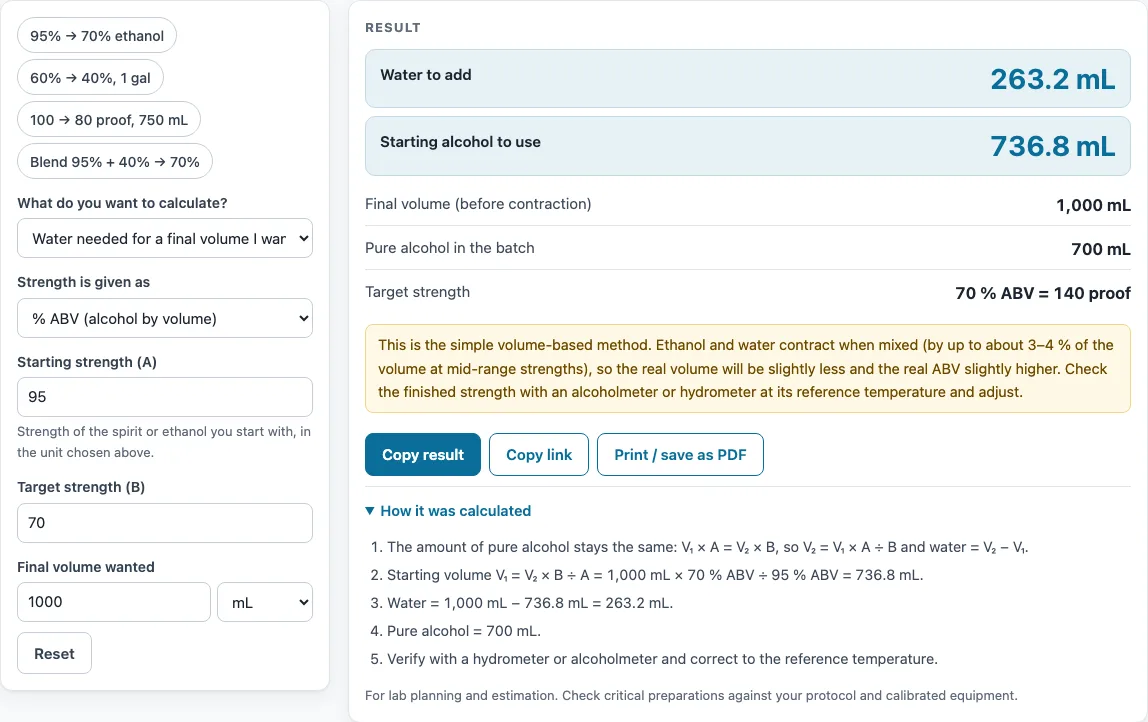
Take the 95 % to 70 % example for a 1,000 mL finished batch. The batch needs 700 mL of pure alcohol (70 % of 1,000 mL). That is 736.8 mL of 95 % spirit, since 736.8 × 0.95 = 700. The remaining 263.2 mL is water. If you start with a volume instead, the calculator uses V_final = V_start × A ÷ B. If you want a set final volume, it uses V_start = V_final × B ÷ A.
How do you blend two spirits to a target proof?
Convert the target and both strengths to % ABV first, since proof is twice the ABV. Then find the share of the stronger spirit with (B − A2) ÷ (A1 − A2), where A1 is the stronger spirit, A2 is the weaker one, and B is the target. The rest of the volume is the weaker spirit.
For example, to make 1 L at 70 % from 95 % and 40 % spirit, the share of the 95 % is (70 − 40) ÷ (95 − 40) = 0.5455. That gives 0.5455 L of 95 % and 0.4545 L of 40 %. Check it by adding up the pure alcohol: 0.5455 L × 0.95 + 0.4545 L × 0.40 = 0.70 L of alcohol in 1 L, which is 70 %.
Why does the real volume come out smaller?
Ethanol and water molecules pack together more tightly than either liquid alone, so 736.8 mL of 95 % ethanol plus 263.2 mL of water gives slightly less than 1,000 mL. The calculator uses the simple volume rule above, which is how most dilution charts are worked out, and adds a reminder to every result. For bottling or for a disinfectant that must meet a stated strength, measure the finished mix with a hydrometer and add a little more water or spirit to correct it.
What strength is used for lab disinfection?
A 70 % ethanol solution is the usual working strength for wiping benches and equipment, which is why “95 % → 70 % ethanol” is one of the presets. Make it fresh from 95 % or 96 % ethanol and purified water, label it with the date, and keep it closed, because ethanol evaporates and the strength drops over time.
Sources
Formulas and data used by this calculator (checked October 2026):
- 27 CFR 5.11, definition of proof (eCFR)
- Artisan Spirit (Spring 2016), volume contraction of ethanol and water
Worked examples
| Input | Result |
|---|---|
| 95 % to 70 %, 1000 mL finished | Add 263.2 mL water to 736.8 mL of spirit |
| 60 % to 40 %, 1 gal | Add 0.5 gal water to 1 gal of spirit |
| 151 proof to 80 proof, 750 mL | Add 665.6 mL water to 750 mL of spirit |
| 96 % to 70 %, 500 mL finished | Add 135.4 mL water to 364.6 mL of spirit |
| 95 % and 40 % blended to 70 %, 1 L total | 0.5455 L of the first + 0.4545 L of the second |
Calculated by the tool above with these values.
Frequently asked questions
How do you convert proof to ABV?
In the US system, divide the proof by 2 to get % ABV. For example, 80 proof is 40 % ABV, and 151 proof is 75.5 % ABV. The calculator converts between the two units for you.
How much water do I add to make 70 % alcohol from 95 %?
For a 1,000 mL finished batch, mix 736.8 mL of 95 % with 263.2 mL of water. Choose the final-volume mode and enter 95 % as the start, 70 % as the target, and 1,000 mL as the volume.
Why is my diluted alcohol stronger or the volume smaller than calculated?
Ethanol and water contract when mixed, by up to about 4 % of the volume depending on the proportions (Artisan Spirit, 2016). The real volume is a little less and the real ABV a little higher than the simple calculation. Mix slowly, let the mix rest and return to room temperature, then check the strength with an alcohol hydrometer (alcoholmeter) at its calibration temperature and adjust.
Can I use the results in commercial work?
Yes. You can use results freely in commercial work such as reports, SOPs, quotes, and product documentation. No attribution is required.
Is my data uploaded anywhere?
No. The calculator runs entirely in your browser, nothing is uploaded, and no sign-up is needed.
Related tools
- Dilution calculator (C1V1 = C2V2): use it for general dilutions where you know the starting and target concentrations.
- Dilution ratio calculator: use it when your dilution is written as a ratio, such as 1:4.
- Specific gravity calculator: use it when you work with density or specific gravity readings.
- Concentration converter: use it to convert a strength from one concentration unit to another.
- PPM calculator: use it when your concentration is in parts per million.
- All laboratory calculators: browse the full set of calculators on this site.