Buffer Calculator
Pick a buffer, a target pH and a volume to get the amounts of the acid and base forms, or find the pH from their concentrations.
The Buffer Calculator is a free tool for making and checking buffer solutions with the Henderson–Hasselbalch equation. In recipe mode you choose a buffer system, the target pH, the total concentration and the volume. It returns the amounts of the acid form and the base form, in moles and in grams, and shows the buffer capacity and the useful pH range. In pH mode you enter the concentrations of the acid and base forms and it gives the pH. Acetate, Tris, MOPS, carbonate and glycine are built in with their pKa values and formulas, and any other buffer works if you type its pKa.
The calculator runs in your browser, so you can use it right away. There is no account or sign-up, and nothing you type is uploaded. For phosphate buffers use the dedicated phosphate buffer calculator linked below.
How to use the buffer calculator
- Under Calculate, choose the amounts for a target pH, or the pH from the acid and base concentrations.
- Choose the buffer system. Pick “Other” to type your own pKa. To try an example, click a preset button such as “50 mM Tris, pH 7.4”.
- In recipe mode, type the target pH, the total buffer concentration (acid form plus base form) and the volume you want to make.
- In pH mode, type the concentration of the acid form [HA] and of the base form [A⁻].
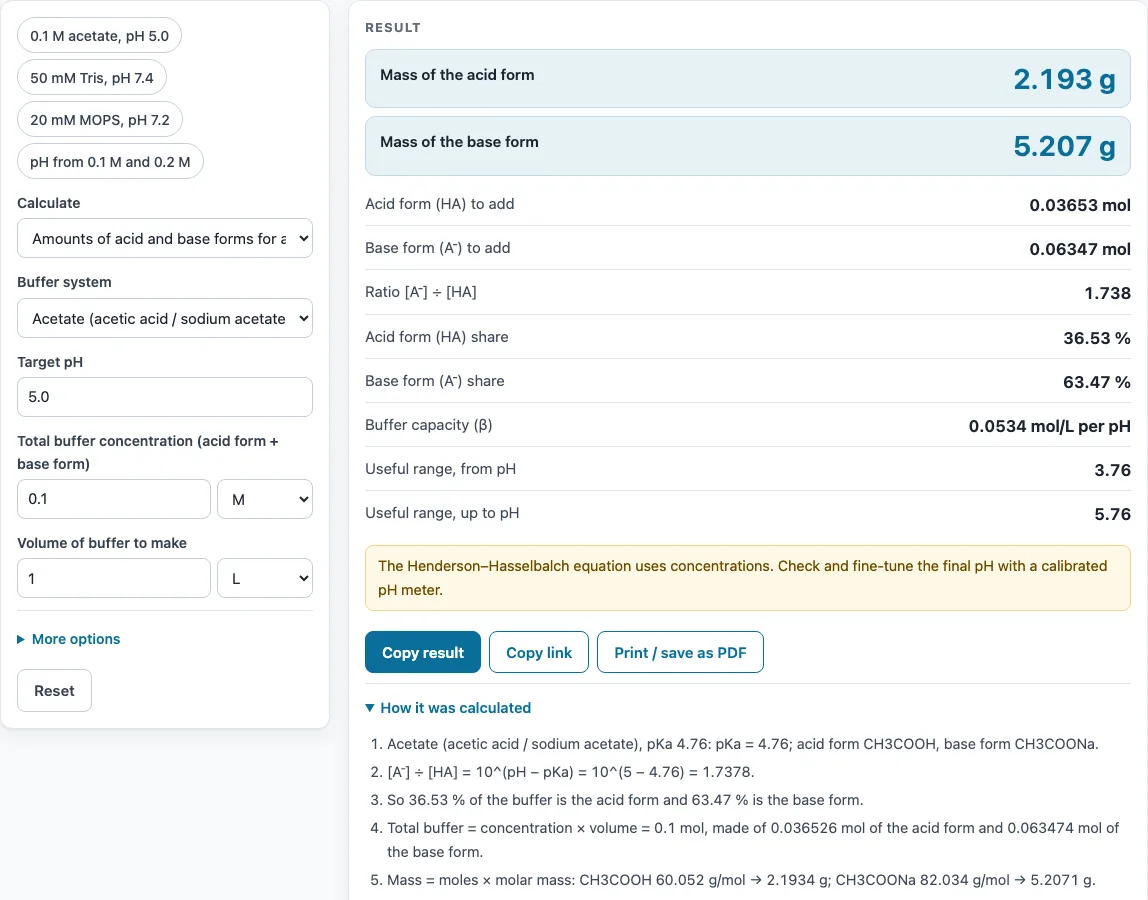
- Read the result. In recipe mode the masses are shown first, with the moles of each form, the ratio, the share of each form and the buffer capacity.
- For your own buffer, open More options and type the molar masses of the acid and base forms if you want grams.
- Check any warning, then open “How it was calculated” to see the steps with your numbers.
- Weigh or measure the two forms, dissolve them in less than the final volume, check the pH with a calibrated meter, and top up to the final volume.
For example, 1 L of 0.1 M acetate at pH 5.0 needs 0.0365 mol of acetic acid (2.193 g) and 0.0635 mol of sodium acetate (5.207 g).
What is the Henderson–Hasselbalch equation?
The Henderson–Hasselbalch equation links the pH of a buffer to the pKa of its weak acid: pH = pKa + log₁₀([A⁻] ÷ [HA]). When the base and acid forms are equal, the pH equals the pKa. If there is twice as much base as acid, the pH is 0.301 units higher. The calculator uses this equation in both directions. It uses concentrations, not activities, so the real pH can differ a little at high ionic strength.
How do you calculate the amounts of acid and base for a buffer?
First find the ratio of base to acid: [A⁻] ÷ [HA] = 10^(pH − pKa). For acetate at pH 5.0 (pKa 4.76) this is 10^0.24 = 1.738, so 63.47 % of the buffer is the base form. Multiply the total moles (concentration × volume) by each share, then multiply by the molar mass of that form to get grams. For 50 mM Tris at pH 7.4 (pKa 8.07) the ratio is 0.2138, so 1 L needs 1.067 g of Tris base and 6.492 g of Tris hydrochloride.
How do you choose the right buffer?
Choose a buffer whose pKa is within one unit of the pH you need. A buffer is most effective when the pH equals the pKa and works poorly when the pH is more than one unit away, which the calculator flags as the useful range of pKa ± 1. For pH 7.4 a buffer with a pKa near 7 to 8, such as MOPS or Tris, is a better choice than acetate.
What is buffer capacity?
Buffer capacity (β) tells how much strong acid or base the buffer can take up for each unit of pH change: β = 2.303 × C × fₐ × f_b, where C is the total concentration and fₐ and f_b are the fractions of the acid and base forms. It is greatest at pH = pKa, where it is 0.576 × C, and it grows in proportion to the concentration. A 0.1 M buffer at its pKa has a capacity of 0.0576 mol/L per pH unit.
What are the pKa values used?
At 25 °C: acetic acid 4.76, Tris (conjugate acid) 8.07, MOPS 7.20, carbonic acid pKa₂ 10.33 for bicarbonate and carbonate, and glycine’s amino group 9.6. The pKa of Tris changes with temperature, so adjust the pH at the temperature you will use it. For other buffers or temperatures, choose “Other” and type the pKa from your supplier’s data sheet.
Sources
Formulas and data used by this calculator (checked October 2026):
- OpenStax Chemistry 2e, 14.6 Buffers
- Wikipedia, Henderson–Hasselbalch equation
- pKa values: Wikipedia articles on acetic acid, Tris, MOPS, carbonic acid and glycine
- IUPAC CIAAW, abridged standard atomic weights (2024)
Worked examples
| Input | Result |
|---|---|
| Acetate (acetic acid / sodium acetate), pKa 4.76, pH 5.0, 0.1 M, 1 L | 0.03653 mol acid form + 0.06347 mol base form |
| Tris (Tris-HCl / Tris base), pKa 8.07, pH 7.4, 50 mM, 1 L | 0.04119 mol acid form + 0.008807 mol base form |
| MOPS (MOPS / MOPS sodium salt), pKa 7.20, pH 7.2, 20 mM, 500 mL | 0.005 mol acid form + 0.005 mol base form |
| 0.1 M acid, 0.2 M base | pH 5.061 |
| Other: enter your own pKa, pH 6.5, 25 mM, 250 mL | 0.00178 mol acid form + 0.00447 mol base form |
Calculated by the tool above with these values.
Frequently asked questions
Can I use the results in commercial work, publications or teaching?
Yes. Results may be used in commercial work, reports, publications and teaching material. You do not need to credit the tool.
Is the buffer calculator free, and is my data uploaded?
The calculator is free and needs no account. Everything is calculated in your browser, and nothing you enter is uploaded. “Copy link” stores your inputs in the page address, so anyone with that link can reopen the same calculation.
Can I print or share the result?
Yes. “Print / save as PDF” prints the inputs, results, calculation steps and the date. “Copy result” copies the result lines with a link.
Can I make a citrate buffer or a Good’s buffer such as HEPES?
Choose “Other” and type the pKa of the acid you use, plus the molar masses if you want grams. Citric acid has three pKa values (3.13, 4.76 and 6.40) that overlap, so the single-pKa equation is only an approximation for citrate.
Why does the final pH differ from the target?
The equation uses concentrations at 25 °C and ignores activity, temperature and any other ions in the solution. Always check and adjust the final pH with a calibrated meter, using a small amount of strong acid or base.
Why does the tool warn me about my values?
Warnings appear when the target pH is outside pKa ± 1, when the concentration is above 1 M or below 1 mM, for Tris (temperature dependence) and carbonate (CO₂ exchange with air), and as a reminder to check the pH with a meter.
Are the results exact?
The amounts are calculated exactly from the equation for the numbers you enter. Check critical preparations against your protocol and a calibrated pH meter.
Related tools
- Phosphate buffer calculator: use it to prepare sodium or potassium phosphate buffers and PBS.
- pH calculator: use it to convert pH, pOH and ion concentrations or find the pH of an acid or base.
- Molarity calculator: use it to weigh the solute for a molar solution.
- Molecular weight calculator: use it to find the molar mass of a buffer component from its formula.
- Titration calculator: use it to draw a titration curve or find an unknown concentration.
- Dilution calculator: use it to dilute a stock solution to a lower concentration.
- All laboratory calculators: use it to browse every calculator on the site.