Doubling Time Calculator
Enter a starting count, a final count and the time between them to get the doubling time, growth rate and generations.
This doubling time calculator works out how long a population takes to double while it is growing exponentially. It is built for cell cultures, but the same maths applies to bacteria, yeast, and any quantity that grows by a fixed factor over time. Enter two counts and the elapsed time to get the doubling time, or enter a doubling time to predict a final number or the time needed to reach a target.
The tool runs entirely in your browser, so nothing you enter is uploaded. It is free and needs no sign-up. Each result comes with a growth curve chart and a breakdown of the calculation.
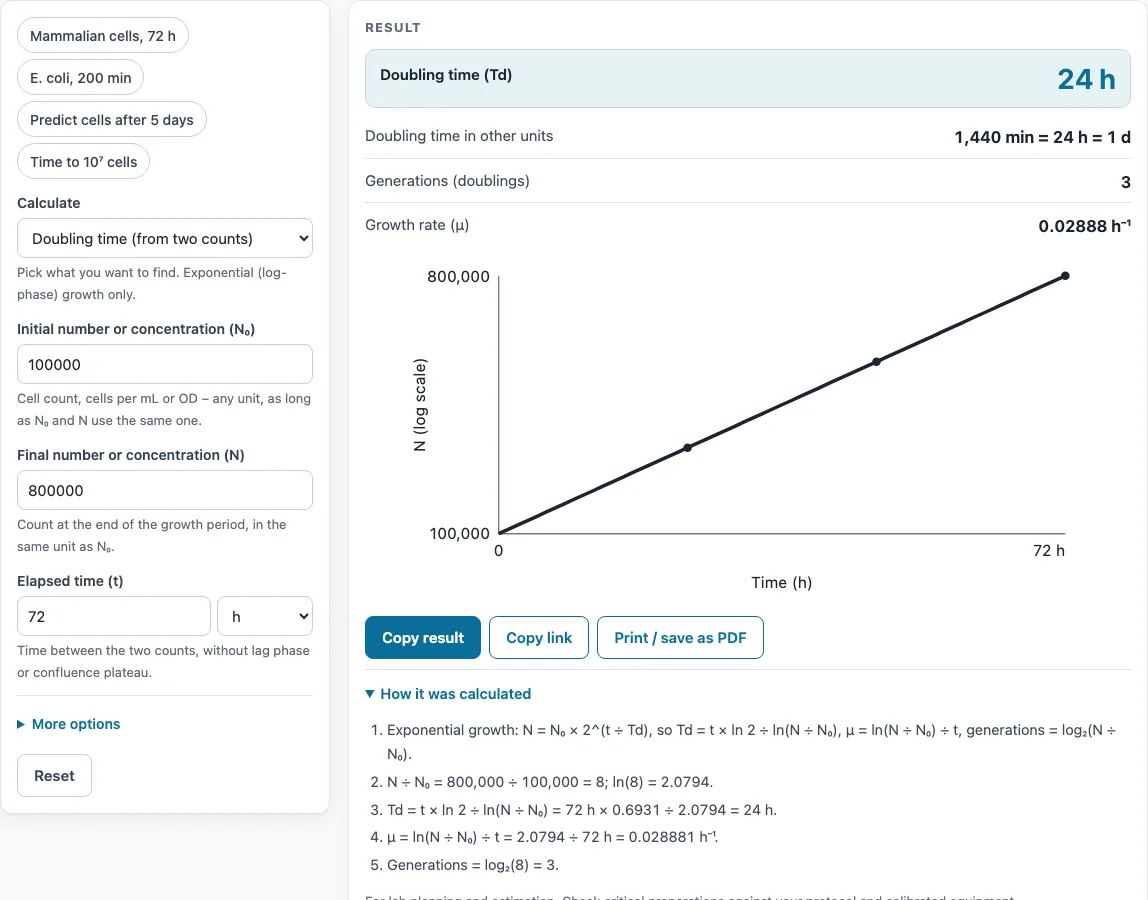
How to use the Cell doubling time calculator
- Choose one of the three modes: doubling time from two counts, final number after a time, or time to reach a number.
- For the doubling time mode, enter the initial count (N₀), the final count (N), and the elapsed time (t).
- For the prediction modes, enter N₀ and the doubling time (Td), then enter either the time (t) or the target count (N).
- Select a time unit: min, h or d. The doubling time is also shown in the other two units.
- Make sure N₀ and N use the same unit, such as cells per mL for both.
- Read the result. The “How it was calculated” section lists the formula and each step with your numbers.
- Check the growth curve drawn under the result. It uses a logarithmic or linear y axis. Exponential growth appears as a straight line on the logarithmic axis.
- Read any warning before you use the figure.
Copy result copies the result lines plus a link to the calculation. Copy link copies the page address, which stores every input in the address (after ?s=), so the same calculation reopens later. Print / save as PDF prints the inputs, results, calculation steps and the date, which is useful for records.
What is the doubling time formula?
The doubling time formula is Td = t × ln 2 ÷ ln(N ÷ N₀). Here N₀ is the starting count, N is the count after elapsed time t, and Td is the time it takes the population to double. ln is the natural logarithm, and ln 2 is a fixed value of about 0.693.
The formula only applies during exponential, or log-phase, growth. Leave out the lag phase at the start of a culture and the plateau at confluence or in stationary phase, because growth is not exponential in those periods. N₀ and N must use the same unit, and t and Td must use the same time unit.
How do you calculate cell doubling time?
To calculate cell doubling time, count the cells at the start and at the end of a log-phase window, then apply the formula. Work through these steps:
- Count the cells at the start (N₀) and after time t, in the same unit.
- Divide N by N₀ to get the fold increase.
- Take the natural log of the fold increase, ln(N ÷ N₀).
- Multiply t by ln 2, then divide by the result from step 3.
For example, take N₀ = 1,000, N = 1,000,000 and t = 200 min. The fold increase is 1,000, and ln 1,000 is about 6.908. Td = 200 × 0.693 ÷ 6.908, which is about 20.07 min.
As a check, a fold increase of exactly 2 means one doubling, so Td should equal t.
Worked example for a mammalian cell line
A flask is seeded and counted in log phase at 100,000 cells; 72 hours later it holds 800,000 cells. The fold increase is 8, ln 8 = 2.079, so Td = 72 × 0.693 ÷ 2.079 = 24 h. That is exactly 3 generations (2 × 2 × 2 = 8), and the growth rate is µ = 2.079 ÷ 72 = 0.0289 per hour. Fast-growing bacteria in rich medium can double in about 20 minutes, while cultured mammalian cells usually take a day or more, so a result far outside the range expected for your cells points to a unit mix-up or counts taken outside log phase.
Sources
Formulas and data used by this calculator (checked October 2026):
Worked examples
| Input | Result |
|---|---|
| N₀ = 100000, N = 800000, t = 72 h | Td = 24 h (3 generations) |
| N₀ = 1000, N = 1000000, t = 200 min | Td = 20.07 min (9.966 generations) |
| N₀ = 200000, Td = 28 h, t = 5 d | N = 3.901 × 10⁶ |
| N₀ = 500000, N = 10000000, Td = 20 min | t = 86.44 min |
Calculated by the tool above with these values.
Frequently asked questions
How do you calculate growth rate from doubling time?
Growth rate µ is ln(N ÷ N₀) ÷ t when you have two counts. If you already know the doubling time, µ = ln 2 ÷ Td, so the value is the same for any starting count.
How many generations have passed?
The number of generations, or doublings, is n = log₂(N ÷ N₀). For N₀ = 100,000 and N = 800,000, the fold increase is 8, so 3 generations have passed. A result that is not a whole number is normal.
How many cells will I have after a number of days?
Use N = N₀ × 2^(t ÷ Td). For example, starting with 200,000 cells and a doubling time of 28 h, after 5 days (120 h) you would have about 3.901 × 10⁶ cells. Convert days to hours or minutes so that t and Td use the same unit.
Can I use cells per mL instead of a cell count?
Yes. N₀ and N can be cell counts, cells per mL, or another measure of the culture, as long as both values use the same unit.
Why does the calculator show a warning?
A warning appears when the final number is not larger than the initial number, because there is no growth and so no doubling time. It also appears when the doubling time is under 6 minutes or over 7 days, which is flagged as implausible. Check your time units first.
Does the formula work for bacteria, yeast or money?
Yes. The formula is the same for any exponential growth, so it applies to bacteria, yeast, populations or money. The growth must still be exponential for the result to be meaningful.
Related tools
- Hemocytometer calculator: use it to convert chamber counts into cells per mL before you enter them as N₀ or N.
- Cell seeding calculator: use it to work out how many cells to plate for a culture.
- Serial dilution calculator: use it when you need to dilute a sample in steps.
- Dilution calculator: use it for single-step dilutions of a stock solution.
- All laboratory calculators: use it to browse every calculator on the site.