Concentration Calculator and Converter
Enter a concentration and the molar mass to see it in molar, mass per volume, percent and ppm units at once.
The Concentration converter is a free calculator that converts one concentration into 14 units at once, so you can finish a concentration calculation without working out each unit by hand. It covers molar units (M, mM, µM, nM), mass units (g/L, mg/mL, µg/mL, ng/mL, mg/L), percent and parts units (% w/v, % w/w, ppm, ppb), and molality (mol/kg). It runs in your browser, nothing is uploaded, and there is no sign-up.
Molar and mass units are linked by molar mass, so the tool needs the MW (g/mol) to convert between them. Units based on solution mass, such as ppm, % w/w and molality, also need the solution density. Enter your starting concentration, choose the target unit, and the main result appears with a table showing the same concentration in every unit. The guide below explains the conversions behind the tool.
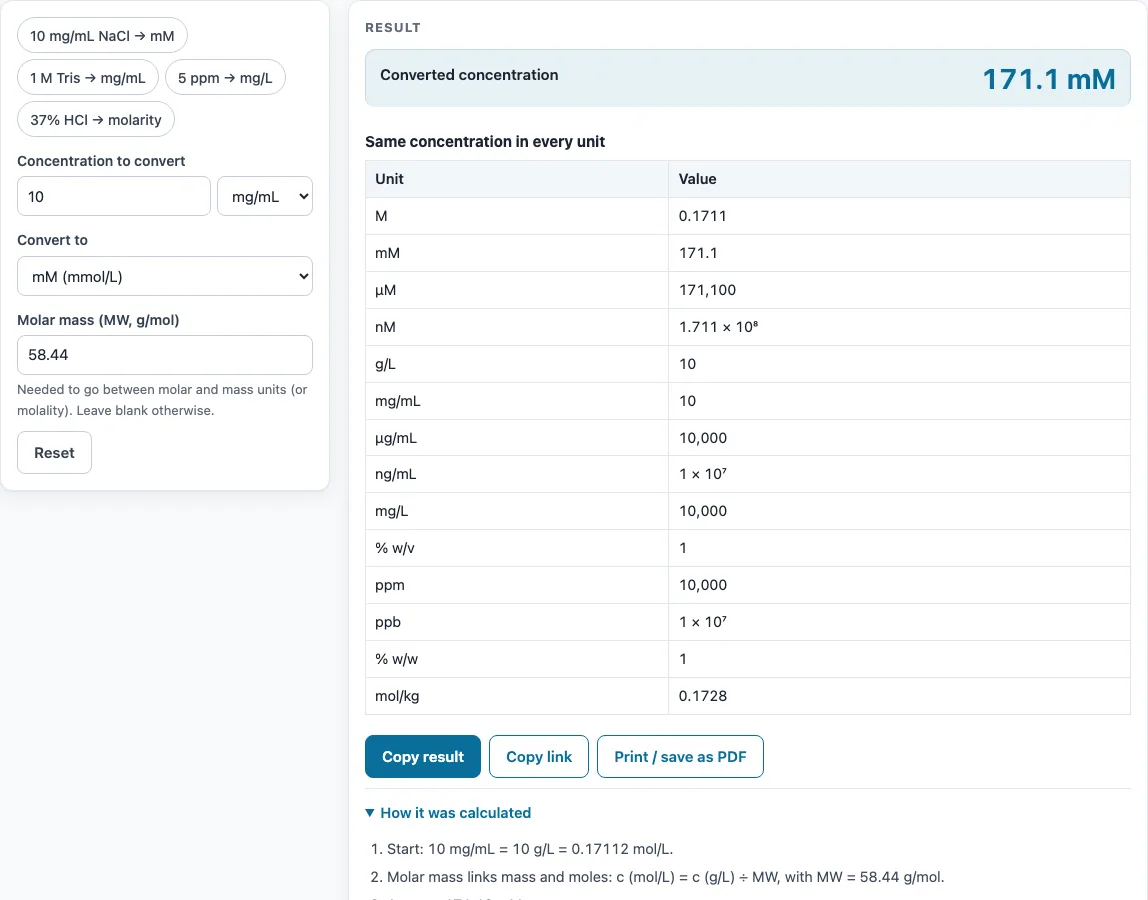
How to use the Concentration converter
- Enter your starting concentration as a number, then choose its unit (for example, mg/mL or M).
- Enter the molar mass (MW, g/mol) of the solute. Units that need an MW show a dash in the table until you do this.
- For ppm, ppb, % w/w or molality, enter the solution density in g/mL. It defaults to 1.000, which suits dilute water solutions. Change it for concentrated or non-water solutions.
- Choose the target unit. The main result updates to show your concentration in that unit.
- Check the table to see the same concentration in all 14 units.
- Open “How it was calculated” under the result to see the formula and each step with your numbers.
- Change any value and every number updates at once; there is no button to press. The density field only appears when the units you chose need it.
Not sure where to start? Use a preset: 10 mg/mL NaCl to mM, 1 M Tris to mg/mL, 5 ppm to mg/L, or 37 % HCl to molarity. Copy result copies the result lines plus a link. Copy link copies the page address, which stores every input in the ?s= parameter so the same calculation reopens later. Print / save as PDF prints the inputs, results, calculation steps and the date.
How do you convert mg/mL to molarity?
To convert mg/mL to molarity, divide the mass concentration by the molar mass. Because 1 mg/mL equals 1 g/L, you can read the mg/mL value directly as g/L, then divide by the MW to get mol/L (M).
The formula is molarity (mol/L) = mass concentration (g/L) ÷ MW (g/mol). The reverse is mass concentration (g/L) = molarity (mol/L) × MW. Multiply mol/L by 1,000 to get mM, or by 1,000,000 to get µM. Use the MW of the exact form you weighed out, since hydrated salts have higher molar masses than their anhydrous forms.
For example, take 10 mg/mL NaCl with MW 58.44 g/mol. 10 g/L ÷ 58.44 g/mol = 0.1711 mol/L, which is 171.1 mM. The amount of solute is unchanged; only the unit changes.
What is the difference between % w/v and % w/w?
% w/v (weight per volume) is grams of solute per 100 mL of solution, so 1 % w/v equals 10 g/L. No density is needed, because the denominator is a volume you can convert directly. % w/w (weight per weight) is grams of solute per 100 g of solution, so it is based on mass and needs the density to reach volume-based units such as molarity.
Take 37 % w/w HCl with MW 36.46 g/mol and density 1.19 g/mL. One litre of this solution is 1,000 mL × 1.19 g/mL = 1,190 g. It contains 37 % of that mass, or 440.3 g of HCl. 440.3 g ÷ 36.46 g/mol = 12.08 mol/L, so the solution is 12.08 M.
What is molality, and when do you need it?
Molality (mol/kg) is moles of solute per kilogram of solvent, not per litre of solution. It does not change with temperature, which is why it is used for freezing-point and boiling-point calculations. To get it from molarity, the converter works out the mass of one litre of solution from the density, subtracts the mass of the solute, and divides the moles by the remaining solvent mass. For dilute water solutions molality and molarity are almost the same number; for concentrated ones they differ a lot, so enter the measured density.
Sources
Formulas and data used by this calculator (checked October 2026):
- OpenStax Chemistry 2e, 3.4 Other units for solution concentrations (%, ppm, ppb)
- OpenStax Chemistry 2e, 3.3 Molarity (dilution, C1V1 = C2V2)
- IUPAC CIAAW, abridged standard atomic weights (2024)
Worked examples
| Input | Result |
|---|---|
| 10 mg/mL, MW 58.44 g/mol | 171.1 mM |
| 1 M, MW 121.14 g/mol | 121.1 mg/mL |
| 100 µM, MW 180.16 g/mol | 18.02 µg/mL |
| 37 % w/w, MW 36.46 g/mol | 12.08 M |
| 5 ppm | 5 mg/L |
Calculated by the tool above with these values.
Frequently asked questions
Is ppm the same as mg/L?
In dilute water solutions, 1 ppm is approximately 1 mg/L, because 1 L of water weighs about 1 kg. Strictly, mg/L = ppm × density. Above 1 % w/v (10 g/L), the shortcut is inaccurate, so enter the real solution density. For example, 5 ppm equals 5 mg/L.
How do you convert millimolar to molar (and micromolar to molar)?
Both are molar units, so no MW is needed. Since 1 M = 1,000 mM, divide mM by 1,000: 250 mM = 0.25 M. Since 1 M = 1,000,000 µM, divide µM by 1,000,000: 100 µM = 0.0001 M.
How do you convert molarity to mg/mL?
Multiply the molarity by the MW. The result is in g/L, which is the same as mg/mL. For 1 M Tris (MW 121.14 g/mol), the result is 121.1 mg/mL. For 100 µM glucose (MW 180.16 g/mol), the result is 0.01802 mg/mL, or 18.02 µg/mL.
How do you calculate concentration?
Divide the amount of solute by the amount of solution, using the unit that matches your question. For molarity, divide moles by litres of solution. For mg/mL or g/L, divide mass by volume. For % w/w and ppm, divide the mass of solute by the mass of solution, then scale to 100 or 1,000,000.
Why does my result show a dash, or seem impossible?
A dash means the unit needs a molar mass and no MW was entered. If a result looks impossible, check your units. A solute concentration cannot be higher than the solution’s density, so a mismatch often points to a wrong unit or density.
Related tools
- Molarity calculator: use it to work out molarity from mass and volume when you start from weighed solute.
- PPM calculator: use it when you need parts per million for solutions or samples.
- Dilution calculator: use it to find the volume of stock needed to reach a lower concentration.
- Molecular weight calculator: use it to find the MW you need for any mass-to-molar conversion.
- Mass to moles calculator: use it to convert a weighed mass into moles before calculating molarity.
- Specific gravity calculator: use it to find the density of a solution when a % w/w or ppm conversion needs it.
- DNA molarity calculator: use it for nucleic acid concentrations, where molarity is based on molecular size.
- All laboratory calculators: browse the full set when you need a different calculation.