Calculate Dilution Ratio and Dilution Factor
Pick how your 1:X ratio is read, then get the concentrate and diluent volumes, the dilution factor or the percent.
To calculate a dilution ratio mix, this free calculator works out how much concentrate and how much diluent (usually water) you need to reach a ratio such as 1:10 or 1:64 in the final volume you choose. Enter the ratio and the volume, and it returns both amounts. It also converts between a ratio, a dilution factor and a percent concentrate, so you can check a lab protocol or a product label the same way.
It works for any liquid concentrate, including lab reagents, bleach, hydrogen peroxide, cleaning chemicals and acids. It runs entirely in your browser, so nothing you enter is uploaded. There is no sign-up.
Ratios on labels and in protocols can be read in two different ways, so the calculator asks which reading you mean before it gives an answer. The sections below cover how to use it, the formulas behind it, and common questions.
How to use the Dilution ratio calculator
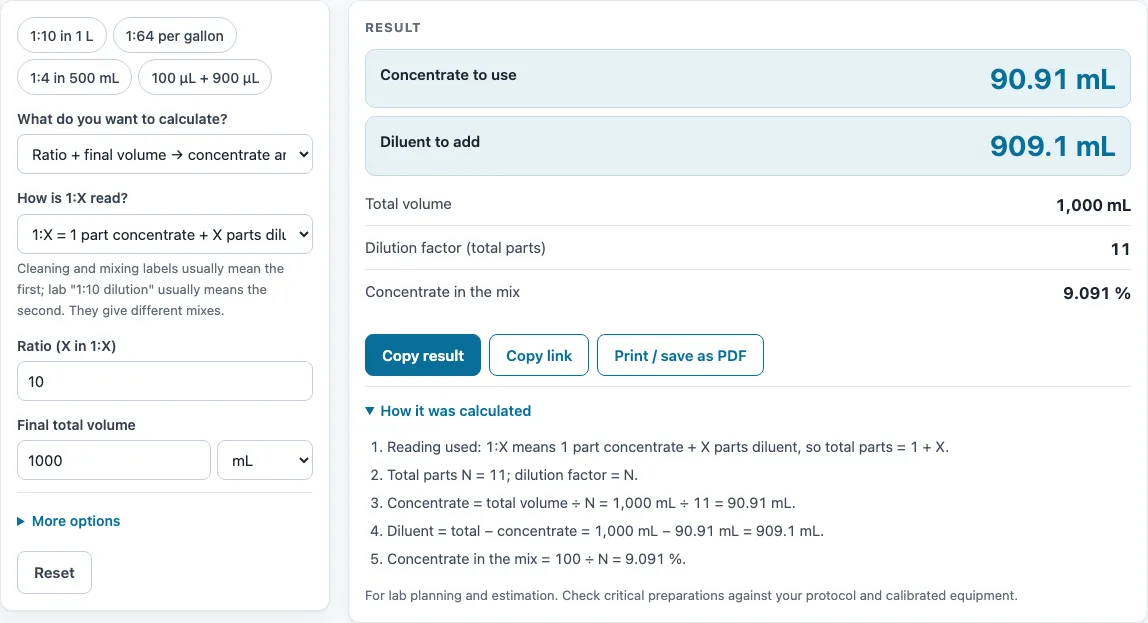
- Choose a mode that matches what you already know: a ratio with a final volume, a ratio with an amount of concentrate, volumes already used, a ratio to percent, or a percent to ratio.
- Enter the ratio by typing the X in 1:X. For 1:10, type 10.
- Under “How is 1:X read?”, choose either 1 part concentrate plus X parts diluent (common on cleaning and mixing labels), or 1 part in X total parts (the usual lab meaning).
- Enter your volume and pick its unit: mL, L, µL, US fl oz, US gal or qt.
- Open More options and set “Show amounts in” if you want the answer in a different unit, such as fluid ounces.
- Read the concentrate and diluent volumes in the result. Open “How it was calculated” to see the formula and each step with your numbers.
- To test the tool, try a preset: 1:10 in 1 L, 1:64 per gallon, 1:4 in 500 mL, or 100 µL + 900 µL.
Copy result copies the result lines plus a link. Copy link copies the page address, which stores every input so the same calculation reopens later. Print / save as PDF produces a page with your inputs, results, calculation steps and the date.
How do you calculate a dilution ratio?
First decide how the ratio is read, because the two readings give different mixes. In the parts reading, 1:X means 1 part concentrate and X parts diluent, so the total is 1 + X parts. The concentrate volume is the final volume divided by (1 + X), and the diluent is the final volume minus the concentrate. For 1:10 in 1,000 mL, that gives 1,000 ÷ 11 = 90.91 mL of concentrate and 909.1 mL of diluent.
In the total-parts reading, 1:X means 1 part in X total parts. The concentrate volume is the final volume divided by X, and the diluent is the rest. The same 1:10 in 1,000 mL gives 100 mL of concentrate and 900 mL of diluent. Check the label or protocol before you mix, because the two readings produce different strengths.
What is the dilution factor formula?
The dilution factor tells you how many times a sample has been diluted. The formula is: dilution factor = total volume ÷ volume of concentrate (sample). Written another way, it is (aliquot + diluent) ÷ aliquot. For example, 100 µL of sample plus 900 µL of diluent gives 1,000 µL in total, and 1,000 ÷ 100 = 10. The dilution factor is 10. The diluent is 9 parts for every 1 part sample, so this is written 1:9 in the parts reading, or 1:10 in the total-parts reading.
The same formula rearranges to give the concentrate needed: concentrate volume = total volume ÷ dilution factor. The tool shows a warning when the dilution factor is above 1,000, because a serial dilution, made in steps, is usually more accurate at that level. It also warns when the concentrate volume is below 0.5 µL, which is too small to pipette reliably.
When you dilute acids, always add the acid to the water, not the water to the acid. Adding water to concentrated acid can cause the mixture to spatter and heat violently.
Sources
Formulas and data used by this calculator (checked October 2026):
Worked examples
| Input | Result |
|---|---|
| Ratio 1:10 (1 part + 10 parts), final volume 1000 mL | 90.91 mL concentrate + 909.1 mL diluent |
| Ratio 1:64 (1 part + 64 parts), final volume 1 gal | 1.969 fl oz concentrate + 126 fl oz diluent |
| Ratio 1:4 (1 part + 4 parts), final volume 500 mL | 100 mL concentrate + 400 mL diluent |
| Ratio 1:10 (1 part in 10 total parts), 1 mL of concentrate | Add 9 mL diluent for 10 mL total |
| 100 µL sample + 900 µL diluent | Dilution factor 10 (ratio 1:9 or 1:10) |
| Ratio 1:32 (1 part + 32 parts) | 3.03 % |
Calculated by the tool above with these values.
Frequently asked questions
What does a 1:10 dilution mean?
It depends on the reading. In the parts reading, it means 1 part concentrate plus 10 parts diluent, for 11 parts in total. In the lab reading, it means 1 part in 10 total parts, so 1 mL of concentrate is brought up to 10 mL with 9 mL of diluent.
How much concentrate do I need for 1:64 per gallon?
In the parts reading, 1:64 in 1 US gallon (128 fl oz) needs 1.969 fl oz of concentrate and 126 fl oz of water. Set “Show amounts in” to fluid ounces to see these figures. Confirm which reading your product uses, since the answer changes.
How do you convert a dilution ratio to a percent?
Divide 100 by the total number of parts. For the parts reading of 1:32 (1 + 32 parts), the total is 33, and 100 ÷ 33 = 3.03 % concentrate. To go the other way, divide 100 by the percent to get the total parts.
How do you calculate the dilution factor?
Divide the total volume by the volume of concentrate or sample. For 100 µL of sample in a total of 1,000 µL, the dilution factor is 1,000 ÷ 100 = 10.
Can I use this calculator for bleach or hydrogen peroxide?
Yes. The calculator works for any liquid concentrate, including bleach, hydrogen peroxide and cleaning chemicals. Use the strength printed on your product label, and follow the manufacturer’s mixing instructions.
Can I use the results in reports or product documentation?
Yes. Results may be used freely in commercial work, such as reports, SOPs, quotes and product documentation. No attribution is required.
Related tools
- Dilution calculator (C1V1 = C2V2) suits cases where you have a starting and target concentration instead of a ratio.
- Serial dilution calculator handles a dilution factor too large for one step, such as anything above 1,000.
- Alcohol dilution calculator brings an alcohol solution down to a target strength.
- PPM calculator converts between parts per million and concentration.
- Concentration converter changes a concentration from one unit to another.
- Hemocytometer calculator counts cells once a sample has been diluted.
- All laboratory calculators lets you browse every calculator on the site.