DNA Concentration Calculator (A260)
Enter the A260 reading and the dilution to get the DNA or RNA concentration, yield and purity ratios.
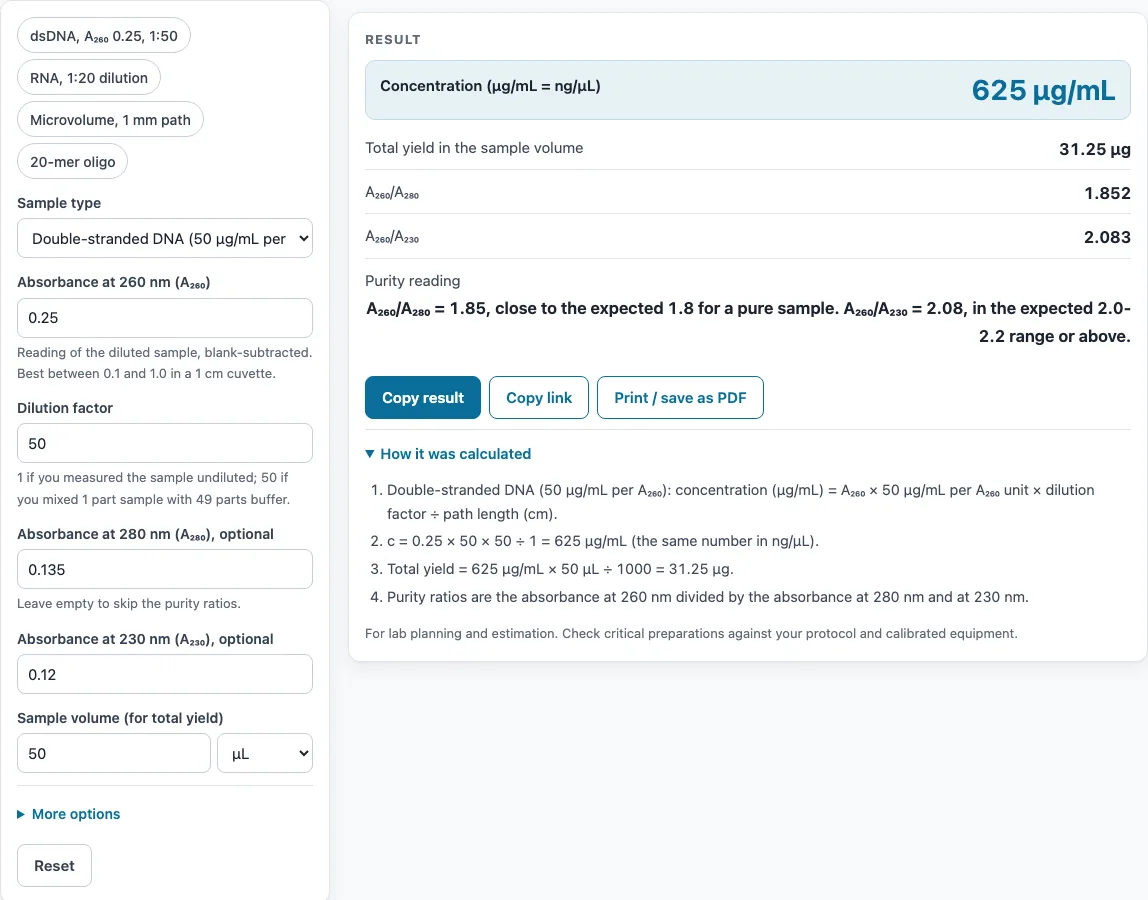
How to use the DNA concentration calculator
- Choose the sample type: double-stranded DNA (50 µg/mL per A260 unit), single-stranded DNA (33 µg/mL), RNA (40 µg/mL), or oligonucleotide (by extinction coefficient).
- Enter your A260 reading.
- Enter the dilution factor. If you diluted the sample 1:50, enter 50. If you did not dilute it, enter 1.
- Set the path length and its unit (cm or mm). A standard cuvette is 1 cm. Microvolume instruments often use 1 mm or 0.5 mm, and the tool corrects for these.
- Optional: enter the sample volume (for example the elution volume) to get the total yield in µg.
- Optional: enter A280 and A230 to get the purity ratios.
- For an oligo, enter the sequence so the tool can calculate ε260, or type in the ε260 from your data sheet.
- For an oligo, also choose DNA or RNA and whether the 5′ end carries a phosphate; both change the molecular weight.
- Read the result, then open “How it was calculated” to check each step against your numbers. Change any input and the result updates immediately.
Copy result copies the result lines and a link. Copy link copies the page address, which stores every input, so the same calculation reopens later. Print / save as PDF prints your inputs, results, calculation steps, and the date.
How do you calculate DNA concentration from A260?
Multiply the A260 reading by the conversion factor for your sample type, then multiply by the dilution factor, and divide by the path length in cm. The result is in µg/mL, which is the same as ng/µL. For example, double-stranded DNA with an A260 of 0.25, diluted 1:50, gives 0.25 × 50 × 50 = 625 µg/mL.
Why is 1 A260 = 50 µg/mL for dsDNA?
The value of 50 µg/mL is an established average for double-stranded DNA measured in a 1 cm path at 260 nm. It is not calculated from your particular sequence. Single-stranded DNA absorbs less at 260 nm per µg, so its factor is 33 µg/mL. RNA is 40 µg/mL.
What does the A260/A280 ratio mean?
The A260/A280 ratio compares absorbance at 260 nm with absorbance at 280 nm, where proteins absorb strongly. A ratio of about 1.8 is expected for pure DNA, and about 2.0 for RNA. A lower ratio suggests protein or phenol contamination.
What does the A260/A230 ratio mean?
The A260/A230 ratio checks for compounds that absorb at 230 nm. A ratio of about 2.0 to 2.2 is expected. A lower ratio suggests carry-over of salts, guanidine, phenol, or carbohydrates from extraction.
How do you calculate oligo concentration from the extinction coefficient?
Use the Beer–Lambert law, c = A ÷ (ε × l), where A is the absorbance, ε is the molar extinction coefficient at 260 nm, and l is the path length in cm. The tool gives the result in µM, and it also converts it to nmol, µg/mL, and molecular weight. The ε260 is calculated from the sequence using the nearest-neighbour method for DNA. For RNA, it is a simple sum of base values and is marked as approximate. You can also type in the ε260 from your data sheet.
The molecular weight for an anhydrous oligo with a 5′-OH is A × 313.21 + C × 289.18 + G × 329.21 + T × 304.2 − 61.96, where A, C, G, and T are the number of each base. A 5′-phosphate option adds the phosphate.
How do you account for the path length on a microvolume instrument?
Divide by the path length in cm, not in mm. A 1 mm path is 0.1 cm, and a 0.5 mm path is 0.05 cm. Using the same double-stranded DNA reading of A260 0.25 with no dilution, a 1 cm cuvette gives 12.5 µg/mL, a 1 mm path gives 125 µg/mL, and a 0.5 mm path gives 250 µg/mL. Enter the path length as it is on your instrument, and the tool does the conversion.
Sources
Formulas and data used by this calculator (checked October 2026):
- Thermo Fisher NanoDrop, note on the 260/280 and 260/230 ratios
- Eppendorf, verification of photometric measurement values (linear range)
- NovoPro, oligo calculation (nearest-neighbour ε260 table, Cantor et al. 1970)
- OligoCalc / Biosyn, oligonucleotide properties calculator (oligo molecular weight)
Worked examples
| Input | Result |
|---|---|
| A₂₆₀ = 0.25, Dilution factor = 50, Double-stranded DNA (50 µg/mL per A₂₆₀) | 625 µg/mL (ng/µL) (total 31.25 µg) |
| A₂₆₀ = 0.8, Dilution factor = 1, Double-stranded DNA (50 µg/mL per A₂₆₀) | 40 µg/mL (ng/µL) (total 1.2 µg) |
| A₂₆₀ = 0.5, Dilution factor = 20, RNA (40 µg/mL per A₂₆₀) | 400 µg/mL (ng/µL) (total 16 µg) |
| A₂₆₀ = 0.3, Dilution factor = 100, Single-stranded DNA (33 µg/mL per A₂₆₀) | 990 µg/mL (ng/µL) (total 99 µg) |
| A₂₆₀ = 0.4, Dilution factor = 100, Oligonucleotide (by extinction coefficient) | 1,231 µg/mL (ng/µL), 201.3 µM (total 123.1 µg) |
Calculated by the tool above with these values.
Frequently asked questions
What A260 range gives a reliable reading?
Eppendorf gives 0.1 to 1.0 A as the usual linear range of a photometer, and the exact range depends on the instrument. If your reading is outside this range, dilute or concentrate the sample and measure it again.
How do I get the total yield in µg?
Enter the sample volume. The total is the concentration multiplied by the volume. For example, 625 µg/mL × 50 µL = 31.25 µg.
Is ng/µL the same as µg/mL?
Yes. 1 ng/µL = 1 µg/mL, because both the mass and the volume differ by a factor of 1,000. The calculator shows the concentration as µg/mL (ng/µL) so you can copy either.
Should I subtract a blank?
Yes. Measure the buffer or water the sample is dissolved in and use the blank-subtracted reading. Salts and residual reagents in the blank otherwise add to A260 and to A230.
Is my data uploaded anywhere?
No. The calculator runs entirely in your browser, so nothing you enter is uploaded.
Can I use the results in commercial work?
Yes. Results may be used freely in reports, SOPs, quotes, and product documentation, and no attribution is required.
How reliable is the oligo result for long sequences?
The nearest-neighbour ε260 is less reliable above about 60 bases. For longer oligos, check the ε260 against your data sheet and enter that value instead.
Related tools
- DNA molarity calculator: use it when you need the molar concentration of a DNA sample.
- Ligation calculator: use it to work out insert and vector amounts for a ligation reaction.
- Protein concentration calculator: use it when you are measuring protein rather than nucleic acid.
- Dilution calculator: use it to work out how much stock and diluent to mix for a target concentration.
- Serial dilution calculator: use it to plan a series of dilutions in fixed steps.
- RPM to RCF calculator: use it to convert centrifuge speed in RPM to relative centrifugal force.
- All laboratory calculators: use it to browse every calculator on the site.