DNA Molarity Calculator
Enter the DNA concentration and length to get the molar concentration, pmol and copies per µL.
This DNA molarity calculator converts DNA or RNA mass concentration (ng/µL) into molar concentration (nM, pM or µM) and back, using the length of the molecule in base pairs (bp) or nucleotides (nt). It handles double-stranded DNA, single-stranded DNA and single-stranded RNA, and it also gives copies per µL, the figure used for qPCR standards.
The calculator runs in your browser. It is free, needs no sign-up, and uploads nothing, so your sequence lengths and concentrations stay on your device. Typical uses are working out how many nM of a library you have before sequencing, how many pmol of a PCR product go into a reaction, and how many copies per µL a qPCR standard contains before you make its dilution series.
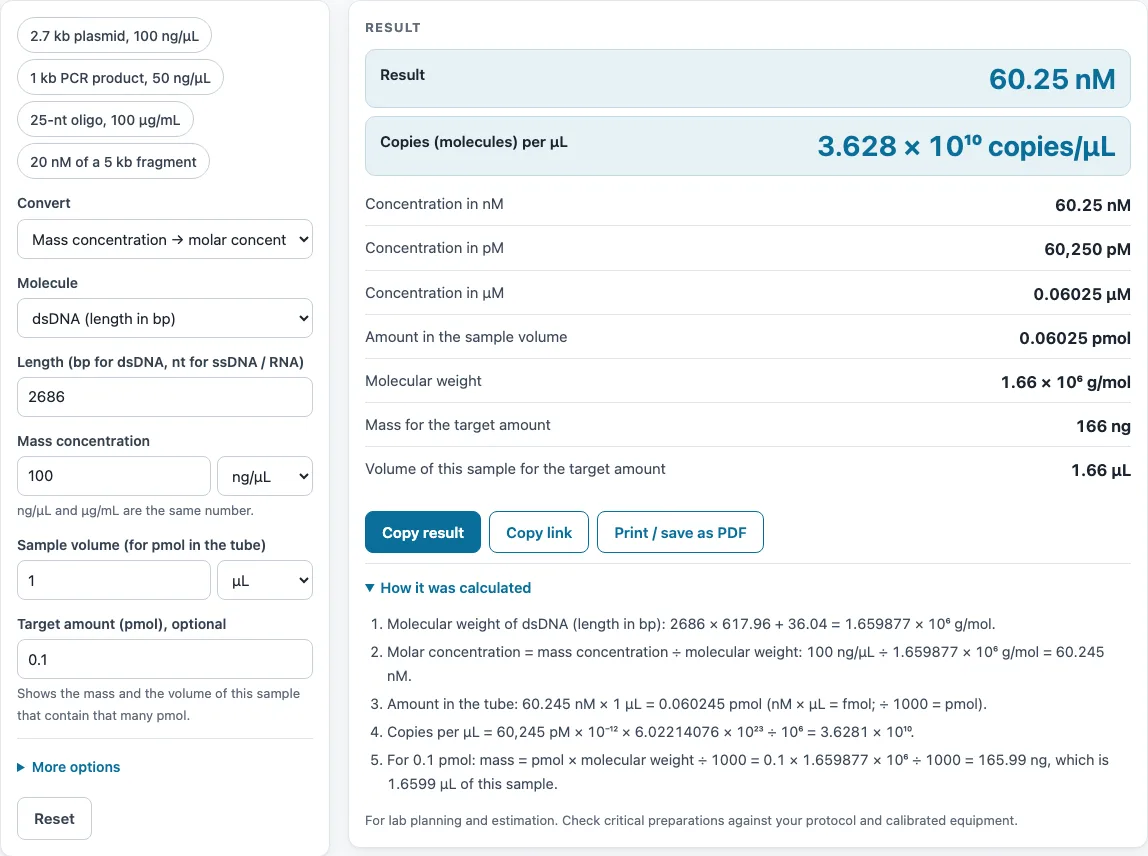
How to use the DNA molarity calculator
- In Convert, choose mass concentration → molar concentration, or the reverse.
- Choose the molecule type: dsDNA (length in bp), ssDNA or ssRNA (length in nt).
- Enter the length of the molecule. Check that you have typed bp or nt, not kb.
- Enter the mass concentration (ng/µL and µg/mL are the same number) or, in the reverse direction, the molar concentration, and pick the unit.
- Optionally enter a sample volume to get the amount in the tube in pmol.
- Optionally enter a target pmol to get the mass and the volume of sample that contain it.
- Read the results: the converted concentration, the same value in nM, pM and µM, copies per µL and the molecular weight used.
- Open “How it was calculated” under the result to see the formula with each step filled in using your numbers.
Use the quick averages option (650 g/mol per bp, 330 g/mol per nt) only for rough estimates, since these are within a few percent of the exact values. Copy result copies the result lines and a link. Copy link copies the page address, which stores every input, so the same calculation reopens later. Print / save as PDF prints the inputs, results, calculation steps and the date.
How do you convert ng/µL to nM for DNA?
Divide the mass concentration by the molecular weight of the molecule, then scale the result to nanomolar. In practice, nM = ng/µL × 10⁶ ÷ MW, where MW is in g/mol.
For example, 100 ng/µL of a 2,686 bp plasmid has a molecular weight of 2,686 × 617.96 + 36.04 = 1,659,876.6 g/mol. Then 100 × 10⁶ ÷ 1,659,876.6 = 60.25 nM.
How do you calculate DNA molarity from length?
Molarity equals mass concentration divided by molecular weight, and the molecular weight is calculated from the length. For double-stranded DNA, MW = bp × 617.96 + 36.04 g/mol. For single-stranded DNA, MW = nt × 308.97 + 18.02 g/mol. For single-stranded RNA, MW = nt × 321.47 + 18.02 g/mol.
Longer molecules have a higher molecular weight, so the same mass contains fewer molecules. A 1,000 bp PCR product at 50 ng/µL gives 50 × 10⁶ ÷ 617,996 = 80.91 nM.
How do you calculate pmol of DNA?
Convert the mass to micrograms, then divide by the molecular weight. For double-stranded DNA, pmol = mass (µg) × 10⁶ ÷ (bp × 617.96 + 36.04).
One picomole is 10⁻¹² mol, and one microgram of a 1,000 bp fragment contains 10⁶ ÷ 617,996 = 1.62 pmol. To get pmol in a tube, multiply the molar concentration by the sample volume, keeping the units consistent (1 nM in 1 µL is 1 fmol).
How do you calculate DNA copy number?
Copy number is the molar concentration multiplied by Avogadro’s constant, 6.02214076 × 10²³ molecules per mole. Convert the molar concentration to mol/µL first, then multiply. For copies per µL, the formula is copies/µL = molar concentration (mol/µL) × 6.02214076 × 10²³.
For 60.25 nM, the molar concentration is 6.025 × 10⁻¹⁴ mol/µL, which gives 3.63 × 10¹⁰ copies/µL. Copy number is the number used to prepare qPCR standards.
What is the molecular weight of a base pair?
A double-stranded base pair contributes about 617.96 g/mol to the molecular weight of DNA. Each single nucleotide of single-stranded DNA contributes 308.97 g/mol, and each nucleotide of single-stranded RNA contributes 321.47 g/mol.
Two small end terms are added to the total: 36.04 g/mol for double-stranded DNA and 18.02 g/mol for single-stranded molecules. Their effect is small for long molecules, but they matter for very short ones.
Sources
Formulas and data used by this calculator (checked October 2026):
- QIAGEN, dsDNA mass to moles converter (617.96 g/mol per bp + 36.04)
- QIAGEN, ssDNA mass to moles converter (308.97 g/mol per nt + 18.02)
- QIAGEN, ssRNA mass to moles converter (321.47 g/mol per nt + 18.02)
- NIST CODATA, Avogadro constant
Worked examples
| Input | Result |
|---|---|
| 100 ng/µL, 2686 bp | 60.25 nM, 3.63 × 10¹⁰ copies/µL |
| 50 ng/µL, 1000 bp | 80.91 nM, 4.87 × 10¹⁰ copies/µL |
| 100 µg/mL, 25 nt | 12.92 µM, 7.78 × 10¹² copies/µL |
| 20 nM, 5000 bp | 61.8 ng/µL, 1.2 × 10¹⁰ copies/µL |
| 1 µg/µL, 1500 nt | 2.02 µM, 1.22 × 10¹² copies/µL |
Calculated by the tool above with these values.
Frequently asked questions
Which should I use: the exact formula or the quick averages?
Use the exact formula for lab records, SOPs and quotes. The quick averages of 650 g/mol per bp and 330 g/mol per nt are only within a few percent, so they suit rough planning.
Why does the tool warn about dsDNA under 20 bp?
Very short double-stranded DNA under 20 bp may not stay annealed, so the strands can separate and the molecular weight you calculate may not match what is in the tube. Check the sequence design before relying on the result.
What if my fragment length is given in kb?
Enter the length in bp, not kb. A 2.7 kb plasmid is 2,700 bp, and entering 2.7 gives a molecular weight that is far too small. Unusually long lengths are flagged as a sign that a unit mix-up may have happened.
Does the calculator work for RNA?
Yes. Choose ssRNA and enter the length in nucleotides; RNA uses 321.47 g/mol per nucleotide because ribose carries one more oxygen than deoxyribose. Double-stranded RNA is not a separate option.
Can I use the results in commercial work?
Yes. Results may be used freely in commercial work, including reports, SOPs, quotes and product documentation, and no attribution is required.
Related tools
- DNA concentration calculator: use it when you need to work out the mass concentration of DNA from another measurement.
- Ligation calculator: use it to set up insert and vector amounts for a ligation reaction.
- Serial dilution calculator: use it to plan a stepwise dilution series from a stock.
- Molarity calculator: use it for molarity of small molecules and solutions outside DNA and RNA.
- Dilution calculator: use it to work out how much stock and diluent to mix for a target concentration.
- Protein molecular weight calculator: use it when your sample is a protein rather than a nucleic acid.
- All laboratory calculators: use it to browse every calculator on the site.