Percent Recovery Formula and Calculator
Enter the starting and recovered amounts, or spike results, to get percent recovery, or actual and theoretical yield for percent yield.
How to use the Percent Recovery Calculator
- Choose a mode: purification / recrystallization recovery (mass), analytical spike recovery (concentration), or percent yield of a reaction.
- For purification or recrystallization, enter the starting mass and the recovered mass. Pick the unit for each: g, mg, kg, oz, or lb. The units may differ, for example a starting mass in g and a recovered mass in mg; the calculator converts them.
- For spike recovery, enter the unspiked sample result, the spiked sample result, and the amount added. Use the same kind of unit for all three.
- If your method or SOP sets acceptance limits, type them in. The defaults of 80 % and 120 % are only starting values. The result will tell you whether your recovery is within, below, or above the limits.
- For percent yield, enter the actual yield and the theoretical yield, each with its own mass unit.
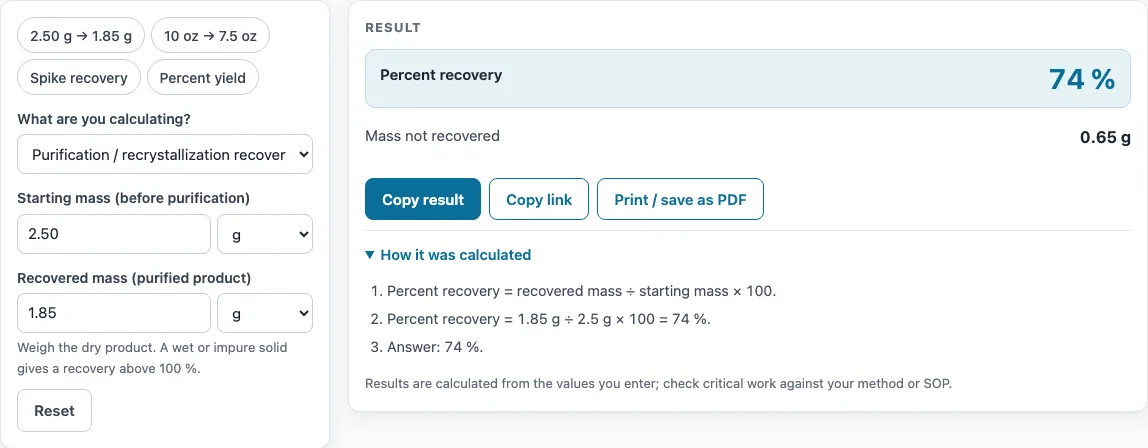
- Read the result. For purification, the calculator also shows the mass not recovered.
- Open “How it was calculated” under the result to see the formula and each step with your numbers.
Use Copy result to copy the result lines with a link. Use Copy link to copy the page address, which stores every input in the address (after ?s=), so the same calculation reopens later. Print / save as PDF produces a printout of your inputs, results, calculation steps, and the date.
What is the percent recovery formula?
Here, % recovery = recovered amount ÷ starting amount × 100. It shows the fraction of a substance that made it through a step, such as recrystallizing a solid.
In purification, the starting amount is the mass of the crude material and the recovered amount is the mass of pure product. Take 2.50 g of crude material that gives 1.85 g of pure product. Then 1.85 ÷ 2.50 = 0.74, and 0.74 × 100 = 74 % recovery, with 0.65 g not recovered.
Recrystallization is nearly always below 100 %. A portion of the product remains in the cold solvent (the mother liquor) and is discarded when the crystals are filtered. Keeping the hot solvent to a minimum means less product stays dissolved, so recovery goes up.
Spike recovery uses a different version of the formula: % recovery = (spiked sample result − unspiked sample result) ÷ amount added × 100. The unspiked result is subtracted to remove whatever the sample already contained before the spike was added. In one example, the unspiked result was 0.5 mg/L, the spiked result was 1.42 mg/L, and 1 mg/L was added. Then (1.42 − 0.5) ÷ 1 × 100 = 92 %. The method or SOP sets the acceptance limits for spike recovery, not the formula itself.
What is the difference between percent recovery and percent yield?
Recovery measures how much of a substance got through a step, such as purification. Yield, expressed as a percentage, compares the product of a chemical reaction with the maximum amount that the reaction could theoretically produce.
Calculated as actual yield ÷ theoretical yield × 100. In one example, 3.1 g of product was obtained from a theoretical yield of 4.2 g, so 3.1 ÷ 4.2 × 100 = 73.81 %. The theoretical yield is worked out from the limiting reagent, so an error in identifying that reagent changes the answer. Recovery follows losses during handling, whereas yield follows how far a reaction went.
Sources
Formulas and data used by this calculator (checked October 2026):
Worked examples
| Input | Result |
|---|---|
| 2.5 g → 1.85 g | 74 % recovered |
| 10 oz → 7.5 oz | 75 % recovered |
| 0.5 mg/L, 1.42 mg/L, 1 mg/L | 92 % recovery (Within the limits) |
| 12 ng/mL, 58 ng/mL, 50 ng/mL | 92 % recovery (Within the limits) |
| 3.1 g / 4.2 g | 73.81 % yield |
Calculated by the tool above with these values.
Frequently asked questions
Why is my percent recovery over 100 %?
A result above 100 % usually points to solvent or impurities still in the product, which inflates its mass. Dry the product to constant mass and weigh it again. With percent yield, a value over 100 % can also come from using the wrong limiting reagent for the theoretical yield.
What is a good percent recovery?
There is no single target that fits every procedure. The acceptable range depends on the method, and for spike recovery the method or SOP sets the limits. The defaults of 80 % and 120 % in the calculator are simply a place to start.
Can spike recovery be negative?
Yes, it can. When the spiked sample reads lower than the unspiked sample, the result comes out negative. Review the sample preparation and the values you entered before you report it.
Do I need to convert units before entering masses?
No conversion is needed. Masses can be entered in g, mg, kg, oz, or lb, and the two masses may differ in unit. For spike recovery, though, all three values need to share one kind of unit, either mass per volume or molar.
Does the calculator store my data?
Nothing leaves your device, since the calculator runs in your browser. Copy link saves the inputs into the page address, so whoever holds that address can view the same numbers.
Related tools
- Molecular weight calculator: finds the molar mass of a compound, which you need before converting between mass and moles.
- Mass to moles calculator: turns a sample’s mass into moles, handy when a reaction calls for specific amounts.
- Molarity calculator: gives the concentration of a solution for spike or standard preparation.
- Significant figures calculator: rounds your recovery or yield result to the correct number of significant figures.
- Titration calculator: works backward from titration volumes to an unknown concentration.
- Concentration converter: switches between units such as mg/L and ng/mL so spike results can be compared.
- All laboratory calculators: a full list of every calculator on the site, for browsing.