pH Calculator
Convert between pH, pOH, hydrogen and hydroxide ion concentration, or find the pH of a strong or weak acid or base.
The pH Calculator is a free tool for the everyday pH calculations of a chemistry or biology lab. It has three modes. The first converts between pH, pOH, hydrogen ion concentration [H⁺] and hydroxide ion concentration [OH⁻], so you can type any one of them and see the other three. The second gives the pH of a strong acid or strong base from its concentration. The third gives the pH of a weak acid or a weak base from its concentration and its Ka, Kb or pK. Weak solutions are solved exactly, without the “x is small” shortcut, and the percent ionization is shown.
The calculator runs in your browser, so you can use it right away. There is no account or sign-up, and nothing you type is uploaded. All values are for water at 25 °C, where pH + pOH = 14.00.
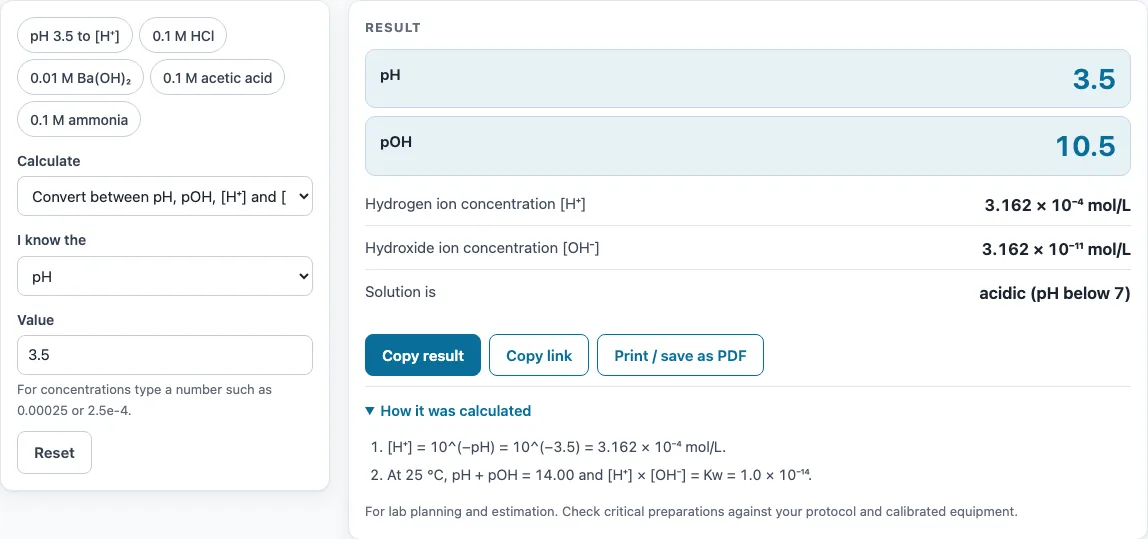
How to use the pH calculator
- Under Calculate, choose to convert between pH, pOH, [H⁺] and [OH⁻], to find the pH of a strong acid or base, or to find the pH of a weak acid or base.
- To try an example first, click one of the preset buttons above the form, such as “0.1 M HCl” or “0.1 M acetic acid”.
- In conversion mode, choose what you know and type the value. Concentrations can be typed as 0.00025 or 2.5e-4.
- For a strong acid or base, choose acid or base, type the concentration in M, mM, µM or nM, and choose how many H⁺ or OH⁻ one formula unit releases. HCl and NaOH release 1, and Ba(OH)₂ releases 2.
- For a weak acid or base, type the concentration, choose whether you have the Ka (or Kb) or the pKa (or pKb), and type its value. Acetic acid has a Ka of 1.8e-5, and so does ammonia as a base (Kb).
- Read the pH and pOH first. Below them are [H⁺], [OH⁻], the percent ionized for weak solutions, and whether the solution is acidic, basic or neutral.
- Open “How it was calculated” to see the formula and the numbers used.
For example, 0.1 M acetic acid with a Ka of 1.8e-5 has an [H⁺] of 1.333e-3 M, so the pH is 2.875 and 1.33 % of the acid is ionized.
How do you calculate pH?
pH is the negative base-10 logarithm of the hydrogen ion concentration: pH = −log₁₀[H⁺], with [H⁺] in mol/L. A solution with [H⁺] = 2.5 × 10⁻⁴ M has a pH of 3.602. In the other direction, [H⁺] = 10^(−pH), so pH 3.5 means [H⁺] = 3.162 × 10⁻⁴ M. Each unit of pH is a tenfold change in [H⁺].
What is the relationship between pH and pOH?
pOH = −log₁₀[OH⁻], and at 25 °C the two scales add up to 14.00: pH + pOH = 14.00. This comes from the ion product of water, [H⁺] × [OH⁻] = Kw = 1.0 × 10⁻¹⁴. A solution with a pOH of 4.2 has a pH of 9.8 and an [OH⁻] of 6.31 × 10⁻⁵ M. The calculator shows all four values so you can use whichever your problem gives. At other temperatures Kw is different, and this tool does not adjust for it.
How do you calculate the hydrogen ion concentration from pH?
Raise 10 to the power of minus the pH: [H⁺] = 10^(−pH). For pH 7 this is 1.0 × 10⁻⁷ M, and for pH 1 it is 0.1 M. Use the conversion mode and choose pH as the known value to get the hydrogen ion concentration, and the hydroxide ion concentration as well.
How do you find the pH of a strong acid or base?
A strong acid is assumed to ionize completely, so [H⁺] equals its concentration times the number of protons it releases, and a strong base gives [OH⁻] in the same way. 0.1 M HCl has a pH of 1.00. 0.01 M Ba(OH)₂ releases two hydroxide ions per formula unit, so [OH⁻] = 0.02 M, the pOH is 1.699 and the pH is 12.301. Below about 10⁻⁶ M the hydrogen ions from water matter too: 1 × 10⁻⁸ M HCl has a pH of 6.978, not 8, and the calculator includes this.
How do you find the pH of a weak acid or base?
A weak acid HA only partly ionizes, and Ka = [H⁺][A⁻] ÷ [HA]. The calculator solves the full charge balance numerically, so the answer is exact. For 0.10 M acetic acid (Ka = 1.8 × 10⁻⁵) it gives [H⁺] = 1.333 × 10⁻³ M, pH 2.875 and 1.33 % ionized. For a weak base the same method gives [OH⁻]. 0.10 M ammonia (Kb = 1.8 × 10⁻⁵) has a pOH of 2.875 and a pH of 11.125. A pKa and a pKb of a conjugate pair add up to 14.00.
Sources
Formulas and data used by this calculator (checked October 2026):
- OpenStax Chemistry 2e, 14.2 pH and pOH
- OpenStax Chemistry 2e, 14.3 Relative Strengths of Acids and Bases
Worked examples
| Input | Result |
|---|---|
| pH = 3.5 | pH 3.5, pOH 10.5 |
| 0.1 M acid | pH 1, pOH 13 |
| 0.01 M base | pH 12.3, pOH 1.699 |
| 0.1 M acid | pH 2.875, pOH 11.12 |
| 0.1 M base | pH 11.12, pOH 2.875 |
Calculated by the tool above with these values.
Frequently asked questions
Can I use the results in commercial work, publications or teaching?
Yes. Results may be used in commercial work, reports, publications and teaching material. You do not need to credit the tool.
Is the pH calculator free, and is my data uploaded?
The calculator is free and needs no account. Everything is calculated in your browser, and nothing you enter is uploaded. “Copy link” stores your inputs in the page address, so anyone with that link can reopen the same calculation.
Can I print or share the result?
Yes. “Print / save as PDF” prints the inputs, results, calculation steps and the date. “Copy result” copies the result lines with a link.
Why is the pH of 1e-8 M HCl not 8?
An acid cannot make a solution basic. At such a low concentration the hydrogen ions from the ionization of water (1 × 10⁻⁷ M at pH 7) are larger than those from the acid, so the pH comes out just below 7. The calculator solves for this, and shows 6.978.
Can I enter a Ka or a pKa?
Both. In weak mode choose “Ka or Kb” to type a plain number such as 1.8e-5, or “pKa or pKb” to type its negative logarithm such as 4.74. For a base, use its Kb or pKb.
Why does the tool warn me about my values?
Warnings appear for concentrations that are very dilute, above 1 M (where activity differs from concentration), constants above 1 (a strong acid or base), weak solutions that are more than 5 % ionized, and pH values outside 0 to 14.
Does the pH match what my pH meter reads?
Not always. The calculator uses concentrations and 25 °C. A pH meter measures hydrogen ion activity, which differs at high concentration or ionic strength, and a pH meter reading also depends on temperature and calibration.
Are the results exact?
The calculation is exact for the numbers you enter. Check critical preparations against your protocol and a calibrated pH meter.
Related tools
- Buffer calculator: use it to find the pH of a buffer or the amounts of acid and base to make one.
- Titration calculator: use it to find an unknown concentration or draw the pH curve of a titration.
- Concentration converter: use it to convert between molar, mass per volume and percent units.
- Molarity calculator: use it to prepare a solution of a known molar concentration.
- Phosphate buffer calculator: use it to prepare phosphate buffers at a set pH.
- Dilution calculator: use it to dilute a stock solution to a lower concentration.
- All laboratory calculators: use it to browse every calculator on the site.