PPM Calculator (Parts per Million)
Convert ppm to ppb, percent and mg/L, work out ppm from the amounts you weighed, or convert gas ppm to mg/m³.
The ppm calculator converts between parts per million (ppm) and related units, and it works out ppm from a measured amount of solute. It handles ppm, ppb, ppt, percent, mg/L, µg/L and mg/kg, converts gas concentrations between ppm and mg/m³, and converts ppm to molarity. It works as a ppm converter, a ppm to ppb calculator, or a parts per million calculator for a single value or a full set of units.
The tool runs in your browser. Nothing is uploaded, there is no sign-up, and it is free. You can use the results freely in reports, SOPs, quotes and product documentation, with no attribution required.
How to use the ppm calculator
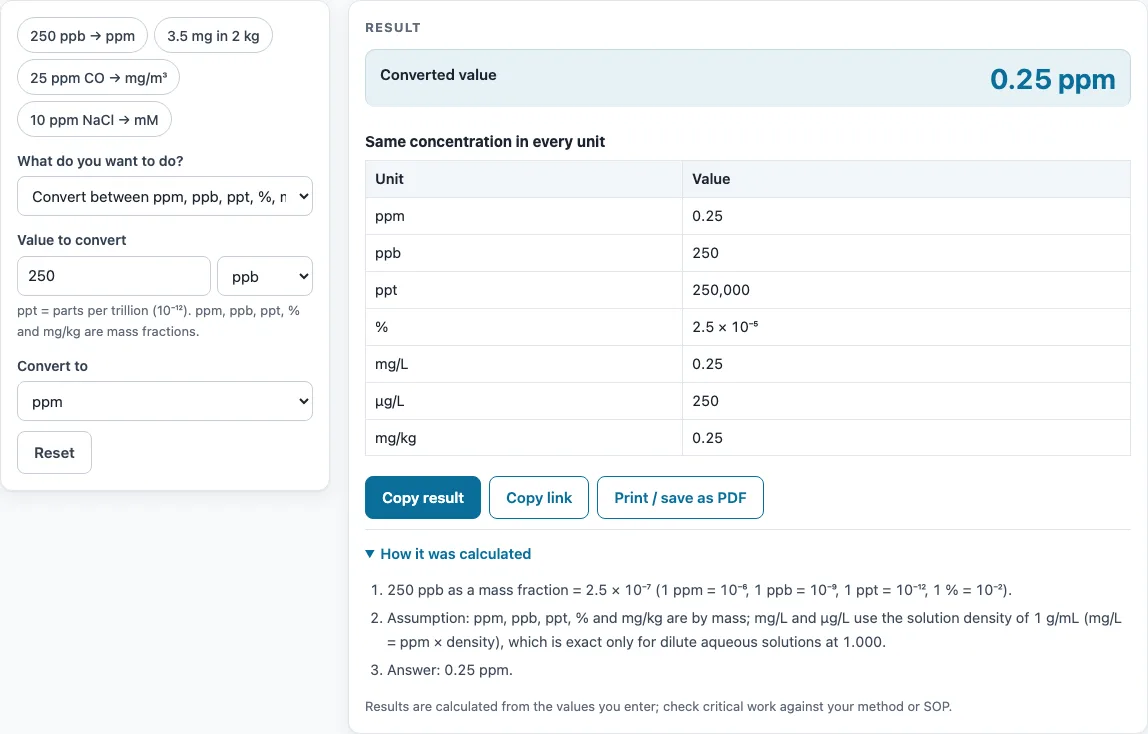
- Open the ppm calculator and choose one of its four modes: convert, find ppm from amounts, gas (ppm(v) ↔ mg/m³), or ppm ↔ molarity.
- In convert mode, enter your value and select its unit: ppm, ppb, ppt, %, mg/L, µg/L or mg/kg.
- Read the table, which shows the value in every unit at once.
- Check the density field, which starts at 1.000. Keep it there for water and dilute aqueous solutions. For other liquids, change it so that mg/L = ppm × density.
- To find ppm from amounts, enter the mass of solute and the mass or volume of the solution. Masses can be in mg, g, kg, oz or lb. A volume uses the density.
- For gas mode, enter the ppm value, the molar mass (MW), the temperature (°C, °F or K) and the pressure (atm, kPa, mmHg, psi or bar).
- For molarity mode, enter the ppm value and the molar mass.
- Open “How it was calculated” under the result to see the formula and each step with your numbers.
Copy result copies the result lines plus a link. Copy link copies the page address, which stores every input (?s=…), so the same calculation reopens later. Print / save as PDF prints the inputs, results, calculation steps and the date.
How do you calculate ppm?
To calculate ppm, divide the mass of solute by the mass of the solution, then multiply by 1,000,000. One ppm means one part of solute in one million parts of solution, measured by mass, which is the same as 1 mg per kg.
For example, if 3.5 mg of solute is dissolved in 2 kg of solution, first convert both masses to the same unit. 2 kg is 2,000,000 mg, so 3.5 ÷ 2,000,000 × 1,000,000 = 1.75 ppm. As a percentage, that is 1.75 × 10⁻⁴ %.
The other units follow fixed relationships. 1 ppm = 1,000 ppb, and 1 ppb = 10⁻⁹ by mass, which is the same as µg/kg. Parts per trillion (ppt) is 10⁻¹². 1 % = 10,000 ppm. Because the tool converts through these fixed ratios, every unit in the table stays consistent.
Is ppm the same as mg/L?
ppm and mg/L are the same only in water and dilute aqueous solutions, which have a density of about 1 g/mL. In that case, 1 ppm = 1 mg/L and 1 ppb = 1 µg/L, so you can treat them as equal for everyday work.
The shortcut does not hold for other solutions. ppm is a mass per mass ratio, but mg/L is a mass per volume measure. For a solution with a different density, mg/L = ppm × density, which is why the density field matters. Above 1 % (10 g/L), the 1 ppm = 1 mg/L shortcut stops being accurate, and above 10,000 ppm the value should be quoted as a percentage instead.
Why do gas ppm values need temperature and pressure?
For gases, ppm usually means parts per million by volume, ppm(v): one millilitre of the gas in a cubic metre of air. Converting that volume to a mass needs the molar volume Vm, which the calculator works out from the ideal gas law, Vm = R·T ÷ P with R = 8.314462618 J/(mol·K). At 25 °C and 1 atm, Vm is 24.47 L/mol; at 0 °C and 1 atm it is 22.41 L/mol. The same 25 ppm of carbon monoxide is therefore a slightly higher mass concentration in cold air than in warm air. Exposure limits are often quoted at 25 °C, so check which conditions your limit or instrument uses before comparing numbers.
Sources
Formulas and data used by this calculator (checked October 2026):
- OpenStax Chemistry 2e, 3.4 Other units for solution concentrations (%, ppm, ppb)
- NIST CODATA, molar gas constant
Worked examples
| Input | Result |
|---|---|
| 250 ppb | 0.25 ppm |
| 3.5 mg / 2 kg | 1.75 ppm (1.75 × 10⁻⁴ %) |
| 25 ppm, MW 28.01 g/mol, 25 °C, 1 atm | 28.62 mg/m³ |
| 50 mg/m³, MW 64.07 g/mol, 77 °F, 14.696 psi | 19.09 ppm |
| 10 ppm, MW 58.44 g/mol | 0.1711 mM |
Calculated by the tool above with these values.
Frequently asked questions
How do you convert ppb to ppm?
Divide the ppb value by 1,000. For example, 250 ppb is 0.25 ppm. To convert ppm to ppb, multiply by 1,000.
How do you convert percent to ppm?
Multiply the percentage by 10,000, because 1 % = 10,000 ppm. For example, 0.01 % is 100 ppm.
How do you convert ppm to mg/m³ for a gas?
Use mg/m³ = ppm × MW ÷ Vm, where Vm is the molar volume from the ideal gas law (Vm = R·T ÷ P). For 25 ppm CO (MW 28.01) at 25 °C and 1 atm, the result is 28.62 mg/m³. Unusual gas temperatures show a warning in the tool.
How do you convert ppm to molarity?
For a dilute aqueous solution, take mg/L equal to the ppm value, then divide by 1,000 and by the molar mass to get mol/L. For example, 10 ppm NaCl (MW 58.44 g/mol) is 0.1711 mM.
What does ppm mean in water testing?
For drinking water, pools and nutrient solutions, results are usually reported as mg/L and called ppm, because the solutions are dilute and 1 L weighs about 1 kg. The convert mode with density 1.000 gives exactly that equivalence.
What is parts per trillion?
Parts per trillion (ppt) is a concentration of 10⁻¹² by mass. It is 1,000 times smaller than ppb, so the tool lists ppt among the units you can convert from.
Can I use the results in commercial work?
Yes. Results may be used freely in reports, SOPs, quotes and product documentation, and no attribution is required.
Related tools
- Concentration converter: use it when you need to convert between concentration units beyond the ppm family.
- Dilution calculator: use it to work out how much stock and diluent to mix for a target concentration.
- Dilution ratio calculator: use it when your dilution is written as a ratio, such as 1:10.
- Molarity calculator: use it when you know the amount of solute and need molar concentration.
- Molecular weight calculator: use it to find the molar mass you need for gas and molarity conversions.
- Specific gravity calculator: use it to find the density of a liquid when the density field needs a value other than 1.000.
- All laboratory calculators: use it to browse every calculator on the site.