Calculate Molecular Weight of Protein
Paste a protein sequence or FASTA to get its molecular weight in Da and kDa, its monoisotopic mass and its composition.
To calculate the molecular weight of a protein, paste its amino-acid sequence here. This free protein molecular weight calculator adds up the residue masses and returns the average molecular weight in daltons (Da) and kilodaltons (kDa), the monoisotopic mass, the sequence length, and a table of amino-acid counts and percentages. If you only know how many amino acids the protein has, an estimate mode gives a rough value.
This mw calculator for proteins runs entirely in your browser, so nothing you paste is uploaded. There is no sign-up. Use it to get a molecular weight for gel work, concentration calculations or mass spectrometry planning, and check the notes below if your protein is modified.
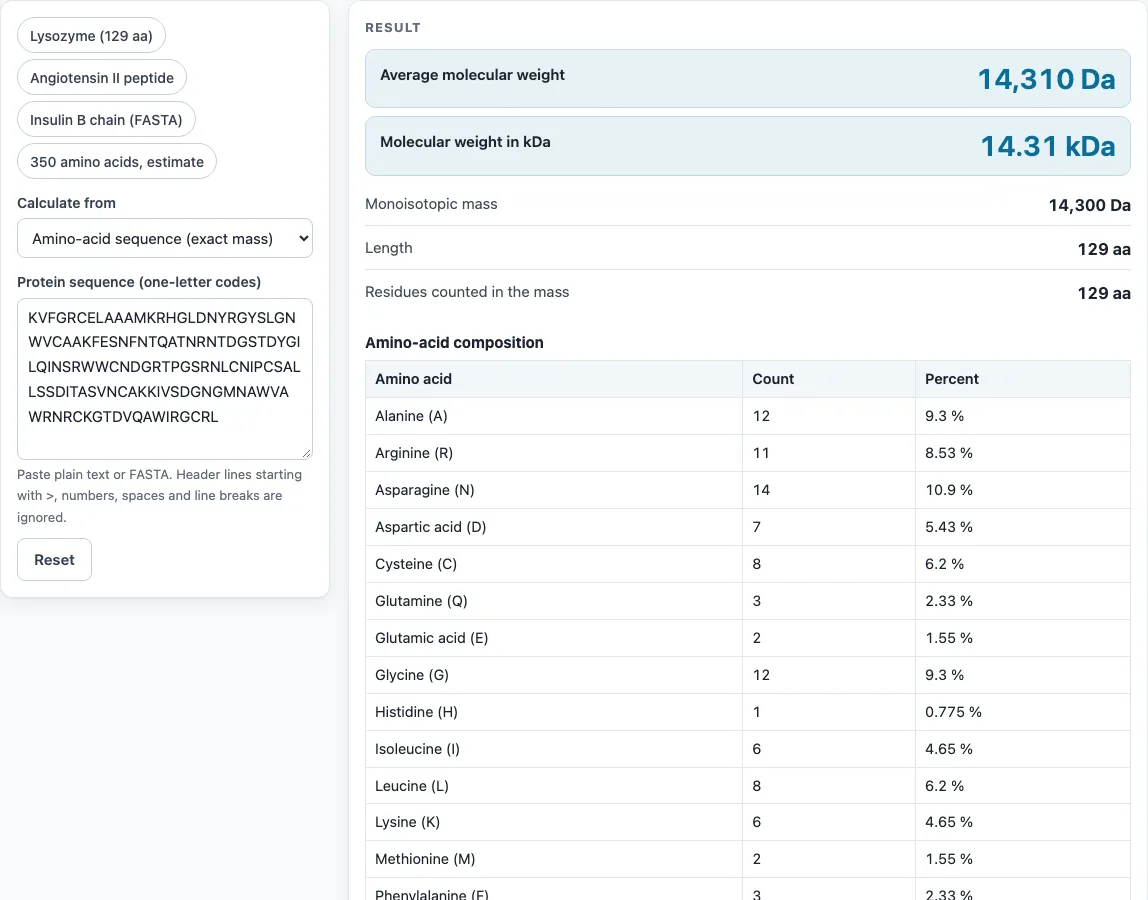
How to use the protein molecular weight calculator
- Leave Calculate from on the amino-acid sequence (exact mass).
- Paste your protein sequence into the input box. Plain one-letter text or FASTA both work, for example a sequence copied from a database entry.
- Leave any header lines, numbers, spaces and line breaks in place. Header lines start with
>, and the tool ignores them. - Read the results, which update as you type or paste: average molecular weight in Da and kDa, monoisotopic mass, length, and the composition table with the count and percentage for each amino acid.
- Check for warnings. The letters B, J, X and Z have no single mass, so they are left out and the result will be too low.
- Open “How it was calculated” under the result to see the formula and each step with your own numbers.
- For a quick figure without a sequence, switch to estimate mode and enter the number of amino acids. This result is labelled approximate.
Copy result copies the result lines plus a link. Copy link copies the page address, which stores every input in the URL (?s=…), so the same calculation reopens later. Print / save as PDF prints the inputs, results, calculation steps and the date.
How do you calculate the molecular weight of a protein from its sequence?
Add up the residue mass of every amino acid in the chain, then add one water molecule (18.015 Da average) for the free N-terminus and C-terminus. A residue is an amino acid after it has joined the chain, so its mass is the amino acid’s formula minus the water lost in forming each peptide bond.
Each peptide bond releases one water molecule, which is why the chain’s total mass is the sum of its residues plus one water. The tool uses the residue formulas and standard atomic weights, and its results agree with common sequence tools to about ±0.1 Da. Hen egg-white lysozyme has 129 amino acids and comes out at 14,313 Da average (14.31 kDa), or 14,303.9 Da monoisotopic. Angiotensin II, with 8 amino acids, gives 1,046.18 Da average.
What is the average mass of an amino acid?
Each amino acid has its own mass, so there is no single value for all of them. Inside a protein chain, the average residue weighs about 110 Da, and that is the figure used for quick estimates.
Individual residues range from light ones such as glycine to heavy ones such as tryptophan. Average masses use natural isotope abundances, which is why they are the right choice for SDS-PAGE, gel filtration and concentration work. The composition table shows which amino acids make up your protein, so you can see which ones pull the average up or down. For a rough answer, multiply the number of amino acids by 110 Da. A 350-residue protein comes out at about 38,500 Da (38.5 kDa). Real proteins differ from this estimate, so use the sequence-based calculation when you need a precise value.
Sources
Formulas and data used by this calculator (checked October 2026):
- ExPASy ProtParam (residue masses; Pace et al. 1995 extinction coefficient)
- IUPAC CIAAW, abridged standard atomic weights (2024)
Worked examples
| Input | Result |
|---|---|
| 129 aa | 14,313 Da average (14.31 kDa), 14,303.9 Da monoisotopic |
| 8 aa | 1,046.18 Da average (1.046 kDa), 1,045.53 Da monoisotopic |
| 30 aa | 3,429.92 Da average (3.43 kDa), 3,427.68 Da monoisotopic |
| 238 aa | 26,886 Da average (26.89 kDa), 26,869.4 Da monoisotopic |
| 350 aa | ≈ 38,500 Da (38.5 kDa) |
Calculated by the tool above with these values.
Frequently asked questions
How do you estimate protein molecular weight from the number of amino acids?
Multiply the number of amino acids by 110 Da, the average mass of a residue. A 350-residue protein is therefore about 38,500 Da (38.5 kDa). Real proteins differ from this, so treat it as an approximation.
What is the difference between average and monoisotopic mass?
Average mass uses natural isotope abundances and suits SDS-PAGE, gel filtration and concentration work. Monoisotopic mass uses the most abundant isotope of each element and is used for mass spectrometry of peptides. For lysozyme, the two values are 14,313 Da and 14,303.9 Da.
Why does my protein run at a different size on SDS-PAGE?
The calculator gives the mass of the unmodified polypeptide chain. Disulfide bonds (each removes 2 H), glycosylation, phosphorylation and signal-peptide removal all change the real mass, so the apparent size can differ from the calculated value.
Why is my result lower than I expected?
The letters B, J, X and Z have no single mass, so the tool leaves them out and shows a warning. The total will then be too low. Replace these letters with the specific amino acid if you know it. U (selenocysteine) and O (pyrrolysine) are accepted.
Does the tool upload or store my sequence?
No. Everything runs in your browser, nothing is uploaded, and no sign-up is needed. The Copy link option stores your inputs only in the page address.
Can I use the results in reports or product documentation?
Yes. Results may be used freely in commercial work, including reports, SOPs, quotes and product documentation. No attribution is required.
Related tools
- Protein concentration calculator: use it to convert a measured protein concentration into molar units once you have the molecular weight.
- Molecular weight calculator: use it for small molecules or compounds you enter by formula rather than as a protein sequence.
- DNA molarity calculator: use it to find the molarity of a DNA sample from its mass and length.
- Molarity calculator: use it to work out how much solute to dissolve for a target molar concentration.
- DNA concentration calculator: use it to estimate DNA concentration from absorbance readings.
- Concentration converter: use it to switch between units such as mg/mL and molar once you have a molecular weight.
- All laboratory calculators: use it to browse every calculator on the site.