RPM to RCF Calculator (Centrifuge g-Force)
Enter the speed and rotor radius to get the relative centrifugal force, or the g-force to get the rpm to set.
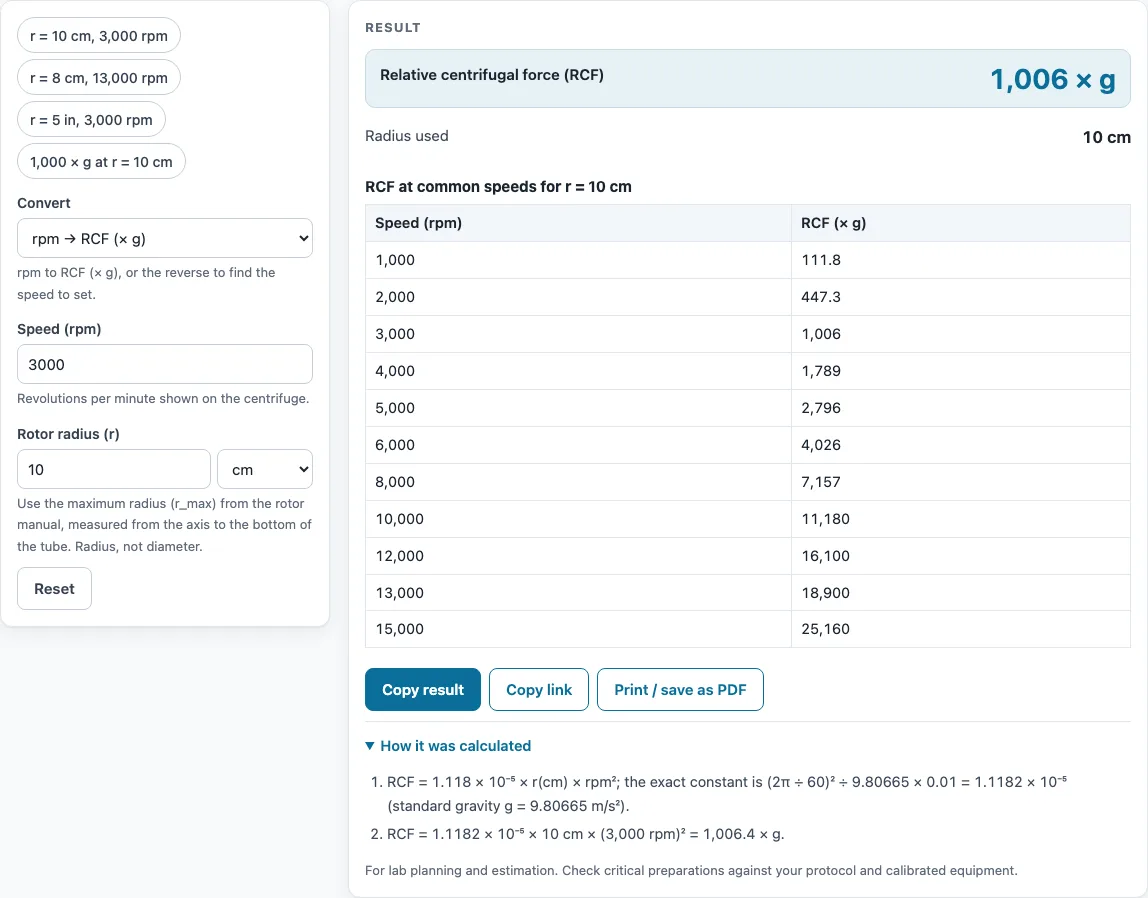
How to use the RPM to RCF calculator
- Choose a mode. Select rpm → RCF (× g) if you know the speed. Select RCF (× g) → rpm if a protocol gives a g-force and you need the speed to set.
- Enter the speed in rpm, or the target RCF in × g if you are in reverse mode.
- Enter the rotor radius and choose its unit: cm, mm or inches. Use the maximum radius (r_max) from your rotor manual, which runs from the rotor axis to the bottom of the tube. Enter the radius, not the diameter.
- Read the result. It shows the RCF in × g, or the rpm to set in reverse mode.
- Scroll to the table under the result. It lists the RCF at common speeds from 1,000 to 15,000 rpm for the radius you entered.
- Open How it was calculated to see the formula with your own numbers in each step.
Under the result, Copy result copies the result lines and a link. Copy link copies the page address, which stores every input in the address (?s=…), so the same calculation opens again later. Print / save as PDF prints the inputs, results, calculation steps and the date, which is useful for lab records.
How do you convert rpm to RCF?
Use the formula RCF = 1.118 × 10⁻⁵ × r × rpm², where r is the rotor radius in cm. Square the speed, multiply by the radius, then multiply by 1.118 × 10⁻⁵. For 3,000 rpm at r = 10 cm, 3,000² × 10 = 90,000,000, and 90,000,000 × 1.118 × 10⁻⁵ ≈ 1,006 × g.
How do you convert RCF (g) to rpm?
Rearrange the formula to rpm = √(RCF ÷ (1.118 × 10⁻⁵ × r)). Divide the target × g by the radius term, then take the square root. For 12,000 × g at r = 8 cm, the result is about 11,580 rpm.
What is the relative centrifugal force formula?
The formula is RCF = 1.118 × 10⁻⁵ × r × rpm², giving the force in multiples of standard gravity (× g). The constant comes from (2π ÷ 60)² ÷ g, with g = 9.80665 m/s², scaled so that r is in cm. The calculator uses the exact constant rather than a rounded value. RCF rises with the square of the speed, so doubling the rpm multiplies the force by four. It rises in direct proportion to the radius.
What radius should I use?
Use r_max from the rotor manual: the distance from the rotor axis to the bottom of the tube at its furthest point. Enter the radius, not the diameter. Lab rotors have radii of roughly 2 to 40 cm, and the calculator warns outside that range, so check the unit and whether you have entered a diameter. For example, 3,000 rpm at r = 5 in (12.7 cm) gives 1,278 × g.
Why do protocols give × g instead of rpm?
RCF depends on the radius, so the same rpm gives different forces in different rotors. A protocol that says 3,000 rpm would give 1,006 × g in a rotor with r = 10 cm, but 1,278 × g in one with r = 5 in. Stating × g lets the protocol work with any centrifuge. You then convert that force to rpm using your own rotor’s radius.
Is RCF the same as g force?
In practice, yes. RCF is also called g-force or × g. The “g” means multiples of standard gravity, so 1,000 × g means the sample experiences a force about 1,000 times that of normal gravity.
Sources
Formulas and data used by this calculator (checked October 2026):
Worked examples
| Input | Result |
|---|---|
| 3000 rpm, r = 10 cm | 1,006 × g |
| 13000 rpm, r = 8 cm | 15,120 × g |
| 12000 × g, r = 8 cm | 11,580 rpm |
| 3000 rpm, r = 5 in | 1,278 × g |
Calculated by the tool above with these values.
Frequently asked questions
What happens if I enter a speed above 150,000 rpm?
The calculator shows a warning for speeds above 150,000 rpm. Check that the value is correct, since real laboratory centrifuges run far below this limit.
Can I enter the diameter instead of the radius?
No. Enter the radius. Using the diameter would make the result exactly twice as high, because RCF is proportional to the radius.
What does the table under the result show?
It shows the RCF at common speeds from 1,000 to 15,000 rpm for the radius you entered. It is useful for comparing speeds without running the calculation again.
Can I use the results in a report or SOP?
Yes. You may use results freely in commercial work, including reports, SOPs, quotes and product documentation. No attribution is required.
Which radius do fixed-angle and swing-bucket rotors use?
Both use r_max, the largest distance from the axis to the sample. In a swing-bucket rotor the tubes swing out horizontally, so r_max is measured with the bucket swung out; rotor manuals list r_max (and often r_min and r_av) for every rotor and adapter.
Is my data sent anywhere?
No. The calculation runs in your browser, so nothing you enter is uploaded.
Related tools
- Hemocytometer calculator: use it to work out cell counts from a hemocytometer chamber reading.
- Cell seeding calculator: use it to plan how many cells to seed into a culture vessel.
- DNA concentration calculator: use it to convert absorbance readings into DNA concentration.
- Protein concentration calculator: use it to estimate protein concentration from assay readings.
- Dilution calculator: use it to find the volumes needed to dilute a stock solution to a target concentration.
- Stress strain calculator: use it to work out stress and strain values from material test data.
- All laboratory calculators: use it to browse every calculator on the site.