Serial Dilution Calculator
Enter the starting concentration, the dilution factor and the number of tubes to get the volumes and concentration of each tube.
How to use the Serial Dilution Calculator
- Choose a mode: plan a serial dilution to build a table for each tube, or plate count to convert colonies into CFU/mL.
- In plan mode, enter the starting concentration and pick its unit from the list, such as M, µg/mL, copies/µL, cells/mL, CFU/mL, PFU/mL or X. For large numbers, type 1e9 for 10⁹.
- Choose the dilution factor per step: 2, 3, 4, 5 or 10-fold, half-log (√10 = 3.162-fold), or a custom value.
- Enter the number of tubes (1 to 40).
- Choose how volumes are set: either the final volume in each tube, or the transfer volume moved at each step.
- Choose whether tube 1 is the first dilution or the undiluted starting solution.
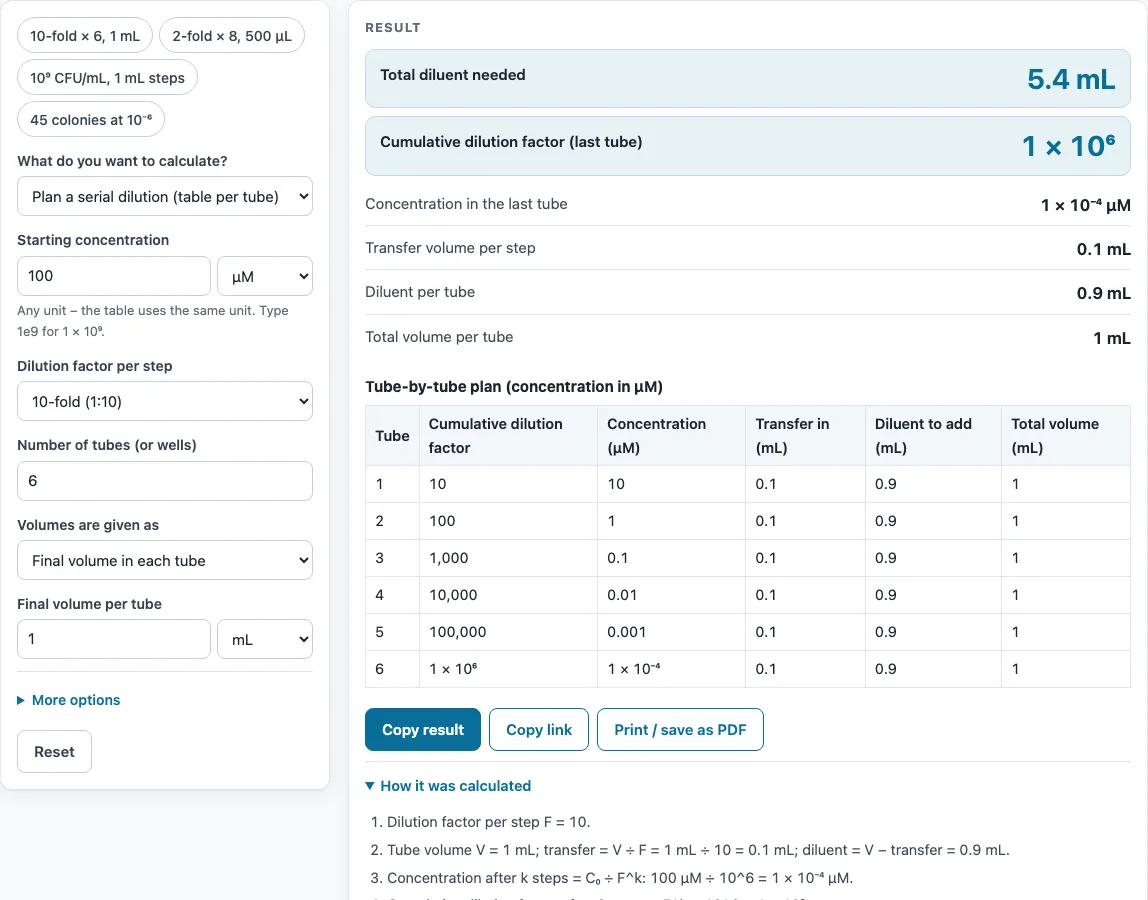
- Read the table. Each row lists the cumulative factor, concentration, transfer from the previous tube, diluent and total volume. The total diluent needed for the series is shown below it.
- In plate count mode, enter the number of colonies, the volume plated in mL, and the dilution of the plated tube. Enter the dilution as the exponent n for 10⁻ⁿ, or as a factor.
- Check the result and its How it was calculated section, which shows the formula with your numbers.
When you are happy with the result, use Copy result to copy the result lines with a link, or Print / save as PDF to print the inputs, results, calculation steps and date. Copy link copies the page address, which stores every input, so the same calculation reopens later.
How do you calculate a serial dilution?
Each tube is made by diluting the previous tube by the same factor, so the concentration falls in equal steps. To find any tube, divide the starting concentration by the dilution factor once for each step. For a 10-fold series, tube 6 is 6 steps from the start, so its concentration is 100 µM ÷ 10⁶ = 1 × 10⁻⁴ µM, as the calculator shows for that setup.
For each tube, the transfer volume is the final volume divided by the dilution factor. The diluent is the final volume minus the transfer. With a 10-fold factor and 1 mL final volume, you move 0.1 mL of the previous tube into 0.9 mL of diluent. Mix each tube well and change tips between transfers, or small carry-over errors will build up down the series. Be careful with very small transfer volumes, which can be too small to pipette accurately, and with large step factors, which magnify pipetting error.
What is the formula for serial dilution (calculation for serial dilution)?
The calculation uses four formulas:
- Transfer volume = final volume ÷ F
- Diluent per tube = final volume − transfer volume
- Concentration in tube n = C₀ ÷ Fⁿ
- Cumulative dilution factor = Fⁿ
Here F is the dilution factor per step, n is the tube number, and C₀ is the starting concentration. If you already know the transfer volume, the final volume is transfer × F.
Take 10 mg/mL, a 2-fold factor, 8 tubes and 500 µL final volume per tube. Each tube’s transfer is 500 µL ÷ 2 = 250 µL, with 250 µL of diluent. The last tube’s cumulative factor is 2⁸ = 256, so its concentration is 10 ÷ 256 = 0.03906 mg/mL.
The half-log factor √10 = 3.162 works in the same formulas. Each tube then carries about half a log unit less than the one before it. For a custom factor, the same formulas apply with your own value of F.
Sources
Formulas and data used by this calculator (checked October 2026):
Worked examples
| Input | Result |
|---|---|
| 100 µM, 10-fold, 6 tubes, 1 mL per tube | Last tube 1 × 10⁻⁴ µM (cumulative factor 1 × 10⁶) |
| 10 mg/mL, 2-fold, 8 tubes, 500 µL per tube | Last tube 0.03906 mg/mL (cumulative factor 256) |
| 1e9 CFU/mL, 10-fold, 7 tubes, 1 mL transferred | Last tube 100 CFU/mL (cumulative factor 1 × 10⁷) |
| 45 colonies, 0.1 mL plated, dilution 10⁻6 | 4.5 × 10⁸ CFU/mL |
| 112 colonies, 100 µL plated, dilution 1/100000 | 1.12 × 10⁸ CFU/mL |
Calculated by the tool above with these values.
Frequently asked questions
How do you make a 10-fold serial dilution?
Move 1 part of the previous tube into 9 parts of diluent, which is a 1-in-10 transfer. For 1 mL transferred, add 1 mL to 9 mL of diluent to make 10 mL. For example, starting at 1e9 CFU/mL with 7 tubes and 1 mL transferred gives a last tube of 100 CFU/mL, a cumulative factor of 10⁷.
How do you make a 2-fold serial dilution?
Mix equal volumes of the previous tube and diluent. For a final volume of 1 mL per tube, transfer 0.5 mL into 0.5 mL of diluent. Each tube’s cumulative factor is then 2, 4, 8, 16 and so on.
How do you calculate CFU/mL from a plate count?
Divide the colony count by the volume plated in mL, then by the dilution of the plated tube. CFU/mL = colonies ÷ (volume plated in mL × dilution). For 45 colonies from 0.1 mL of the 10⁻⁶ tube, CFU/mL = 45 ÷ (0.1 × 10⁻⁶) = 4.5 × 10⁸. The same method gives PFU/mL for a plaque assay.
What is the dilution factor of each tube?
The cumulative dilution factor of tube n is Fⁿ, where F is the per-step factor. In a 10-fold series, tube 3 has a cumulative factor of 1000. In a 2-fold series, tube 3 has a factor of 8. Tube 1 is the first dilution unless you choose the undiluted starting solution for it.
What colony count can I count on a plate?
Aim for a plate with about 30 to 300 colonies. The calculator warns you when a count falls outside this usual countable range, so choose a dilution that puts your plate inside it.
Is the serial dilution calculator free to use for work?
Yes. It is free, needs no sign-up, and runs in your browser, so nothing is uploaded. You may use the results freely in commercial work such as reports, SOPs, quotes and product documentation, and no attribution is required.
Related tools
- Dilution calculator (C1V1 = C2V2) for finding how much stock and diluent to mix for one target concentration, rather than a series of tubes.
- Dilution ratio calculator for converting a dilution expressed as a ratio into its factor and volumes.
- Hemocytometer calculator for converting cell counts from a counting chamber into cells/mL.
- DNA molarity calculator for converting a DNA mass concentration into molar concentration.
- Cell seeding calculator for working out how many cells to plate per well or flask.
- Concentration converter for changing a concentration from one unit to another before you set up a dilution.
- All laboratory calculators for browsing every calculator on the site.