Specific Gravity Calculator
Convert density to specific gravity at a chosen water temperature, specific gravity to density, or API gravity to SG.
The specific gravity calculator converts between density and specific gravity, and between specific gravity and API gravity. Specific gravity is the density of a sample divided by the density of water at a reference temperature, so the result has no unit.
The tool has five modes: density to specific gravity, specific gravity to density, API gravity to specific gravity, specific gravity to API gravity, and mass to volume (or volume to mass) of a liquid from its specific gravity. It runs in your browser, is free, and needs no sign-up. Nothing you enter is uploaded. It is used for lab solutions, brewing and syrups, fuels and oils, and for converting between mass and volume when buying or dosing liquids.
How to use the Specific gravity calculator
- Choose a mode, such as density → specific gravity or API gravity → specific gravity.
- Type your value into the input field. For a mass or volume calculation, enter the specific gravity and the mass or volume you know.
- If the mode uses density, select its unit: g/mL, kg/m³, US lb/gal or lb/ft³.
- Select the reference water temperature: 20 °C (68 °F), 60 °F (15.56 °C), 25 °C (77 °F) or 4 °C (39.2 °F).
- In the API modes, enter the API gravity or the specific gravity; API is always defined at 60 °F, so no water temperature is asked.
- In the mass ↔ volume mode, choose Volume from mass or Mass from volume, enter the specific gravity and the amount you know, and pick units such as kg, lb, L or US gal.
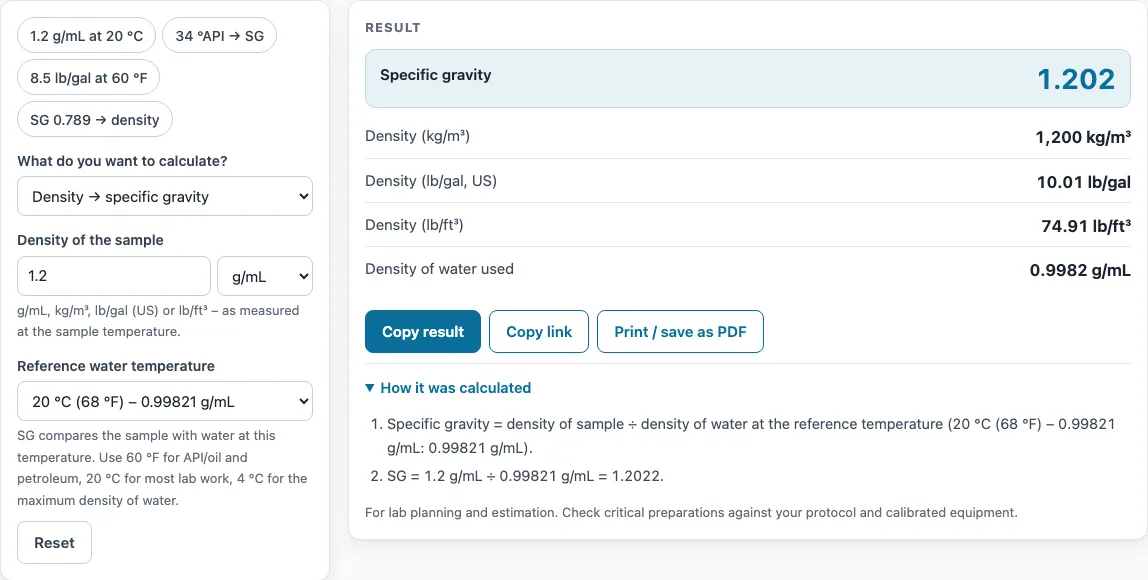
- Read the result. Density outputs are shown in g/mL, kg/m³, lb/gal and lb/ft³ at once, so the page also works as a specific gravity converter between unit systems. Open “How it was calculated” under it to see the formula and each step with your own numbers.
After you have a result, you can use Copy result to copy the result lines with a link, or Copy link to copy the page address. The page address stores every input (the ?s= part), so the same calculation reopens exactly as you left it. Print / save as PDF prints the inputs, results, calculation steps and the date, which is useful for records.
How do you find specific gravity?
Divide the density of your sample by the density of water at the reference temperature. The density units cancel, so the answer is a plain number. For example, a liquid with a density of 1.2 g/mL, compared with water at 20 °C (0.998207 g/mL), has a specific gravity of 1.2 ÷ 0.998207 = 1.202.
Water’s density changes with temperature, so the reference matters. The calculator uses four reference points: 20 °C (68 °F) at 0.998207 g/mL, 60 °F (15.56 °C) at 0.999017 g/mL, 25 °C (77 °F) at 0.997047 g/mL, and 4 °C (39.2 °F) at 0.999975 g/mL. A density of 8.5 lb/gal against water at 60 °F gives a specific gravity of 1.02.
What is the difference between density and specific gravity?
Density is a physical quantity with units. It is the mass of a substance per unit volume, such as g/mL or kg/m³. Specific gravity is a ratio: the sample’s density compared with water’s density at a stated temperature. Because it is a ratio, it has no unit, and it stays the same whichever density unit you use, as long as both densities use the same unit.
Specific gravity is also called relative density.
API gravity is a scale used for oil and petroleum. The two formulas are API = 141.5 ÷ SG − 131.5 and SG = 141.5 ÷ (API + 131.5), both at 60 °F/60 °F. Water is 10 °API, and light crude is about 30–40 °API, so a higher API value means a lighter oil. For example, 34 °API gives an SG of 0.855, and an SG of 0.85 gives 34.97 °API.
How do you use specific gravity to find mass or volume?
Specific gravity also links to mass and volume, which is handy when a tank or drum is sold by weight but used by volume. Mass = SG × density of water × volume, and volume = mass ÷ (SG × density of water). With an SG of 0.85 and a volume of 1 US gallon, the mass is 7.087 lb. Going the other way, 100 kg of a liquid with SG 1.2 at 20 °C occupies 100 ÷ (1.2 × 0.998207) = 83.5 L.
Sources
Formulas and data used by this calculator (checked October 2026):
- Tanaka et al. (2001), density of water equation, Metrologia 38:301
- API gravity definition (141.5 ÷ SG − 131.5)
- NIST Special Publication 811, unit conversion factors
Worked examples
| Input | Result |
|---|---|
| Density 1.2 g/mL, water at 20 °C (68 °F) – 0.998207 g/mL | SG = 1.202 |
| Density 8.5 lb/gal, water at 60 °F (15.56 °C) – 0.999017 g/mL | SG = 1.02 |
| SG 0.789 against water at 20 °C (68 °F) – 0.998207 g/mL | 0.7876 g/mL = 6.573 lb/gal |
| 34 °API | SG = 0.855 |
| SG 0.85 at 60/60 °F | 34.97 °API |
| SG 0.85, volume 1 gal | 7.087 lb |
Calculated by the tool above with these values.
Frequently asked questions
How do you convert density to specific gravity?
Divide the density by the density of water at your chosen reference temperature. For a density of 1.2 g/mL against water at 20 °C, the specific gravity is 1.202.
How do you convert specific gravity to density?
Multiply the specific gravity by the density of water at the reference temperature. An SG of 0.789 against water at 20 °C gives 0.7876 g/mL, which is 6.573 lb/gal.
How do you convert API gravity to specific gravity?
Use SG = 141.5 ÷ (API + 131.5), which applies at 60 °F/60 °F. For example, 34 °API gives an SG of 0.855.
What reference temperature should I use?
Use 60 °F (15.56 °C) for oil and petroleum work, where API gravity is used. Use 20 °C (68 °F) for most lab work. If a standard or report specifies a temperature, use that one and state it with your result.
What does the warning about values above 22.6 mean?
A specific gravity above 22.6 would be denser than osmium, the densest element, so the value usually points to a units mistake. Check that the density is in the unit you selected. An API value below 10 means the material is denser than water.
Is specific gravity the same as relative density?
Yes. Both terms describe the ratio of a sample’s density to the density of water at a stated temperature.
Related tools
- Alcohol dilution calculator: use it to work out how to dilute an alcohol solution to a target strength.
- Concentration converter: use it to convert a solution’s concentration from one unit to another.
- Molarity calculator: use it to find the molar concentration of a solution from its mass and volume.
- PPM calculator: use it to express small concentrations in parts per million.
- Stress strain calculator: use it to work out stress, strain and related material properties.
- All laboratory calculators: use it to browse every calculator on the site.