Stoichiometry Calculator
Enter a chemical equation and the amounts you have to find the limiting reagent, theoretical yield and percent yield.
The Stoichiometry Calculator is a free tool that works with a chemical equation and the amounts you have. Type the equation, and the tool balances it if you leave out the coefficients. Then enter the mass or moles of one or more reactants. With two or more reactants it finds the limiting reagent, the theoretical yield of the product, and how much of each other reagent is left over. With one reactant it shows how much of every other substance is needed and made. If you type the amount of product you collected, it also gives the percent yield.
The calculator runs in your browser, so you can use it right away. There is no account or sign-up, and nothing you type is uploaded. Molar masses come from the formulas, using the current IUPAC atomic weights.
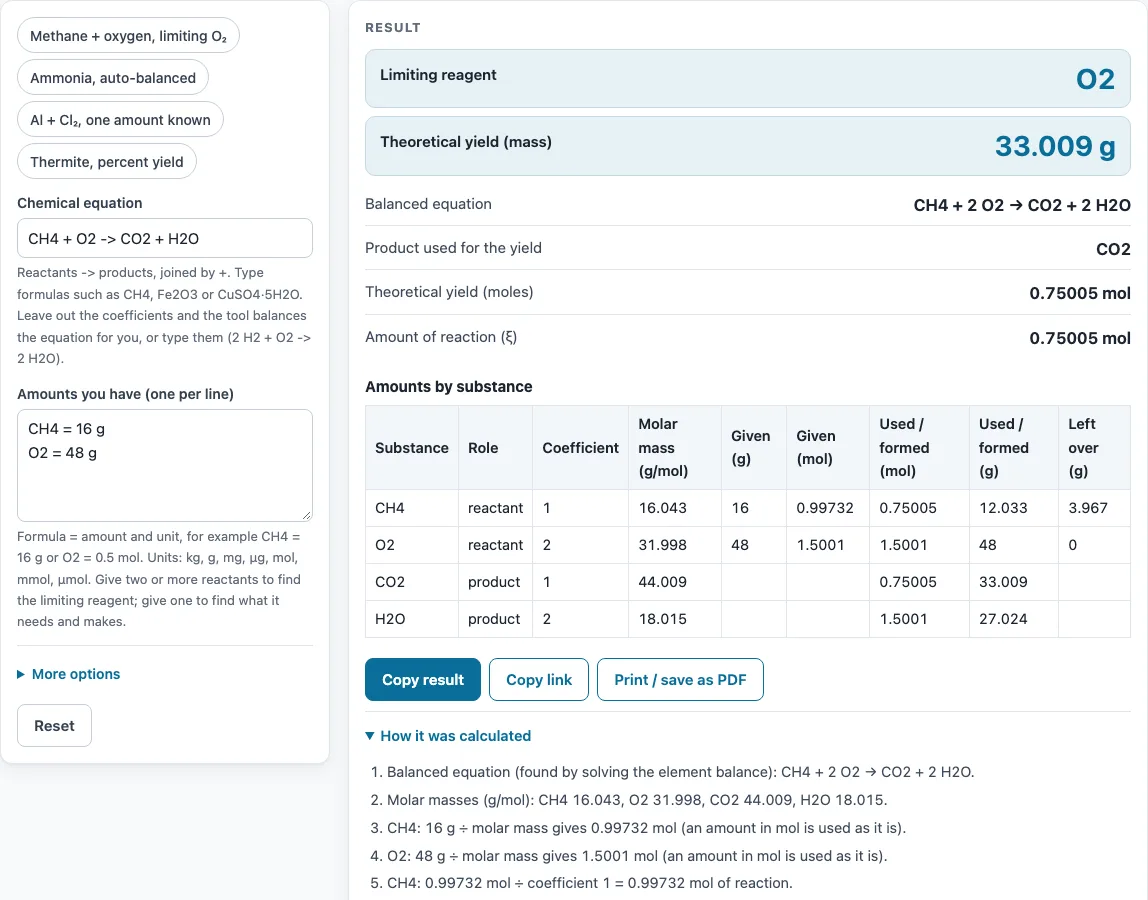
How to use the stoichiometry calculator
- Type the equation under Chemical equation, with reactants on the left of the arrow (->) and products on the right, joined by + signs, for example CH4 + O2 -> CO2 + H2O.
- Leave out the coefficients if you want the tool to balance the equation. If you type them, the equation must already be balanced.
- Under Amounts you have, write one substance per line as formula = amount unit, for example CH4 = 16 g and O2 = 48 g. You can use kg, g, mg, µg, mol, mmol or µmol.
- Read the result. The limiting reagent and the theoretical yield are shown first, and the balanced equation is repeated below them.
- Open the table of amounts by substance. It shows the moles and grams of each substance that are used up or formed, and the grams of each reactant left over.
- To get the percent yield, open More options and type the actual yield of a product, for example Fe = 12.1 g.
- Open “How it was calculated” to see each step with your numbers filled in.
For example, 16 g of methane and 48 g of oxygen balance to CH4 + 2 O2 -> CO2 + 2 H2O. Methane gives 0.9973 mol of reaction and oxygen gives 0.7500 mol, so oxygen is the limiting reagent and the theoretical yield of CO2 is 33.01 g, with 3.967 g of methane left over.
How do you do stoichiometry?
Stoichiometry uses the coefficients of a balanced equation as mole ratios. First convert each amount to moles by dividing the mass by the molar mass. Then use the ratio from the equation to convert moles of one substance into moles of another, and convert back to grams if you need a mass. In 2 Al + 3 Cl2 -> 2 AlCl3, 5.00 g of aluminium is 0.1853 mol. It needs 1.5 times as many moles of chlorine (0.2780 mol, or 19.71 g) and makes 0.1853 mol of AlCl3, which is 24.71 g.
How do you find the limiting reagent?
Divide the moles of each reactant by its coefficient in the balanced equation. This gives the amount of reaction each reactant could support. The reactant with the smallest value runs out first, so it is the limiting reagent, and the other reactants are in excess. The calculator shows these values step by step. If two reactants give the same value, they are used up together and both are listed.
How do you calculate the theoretical yield?
The theoretical yield is the mass of product made when the limiting reagent is completely used, with no loss. Multiply the product’s coefficient by the amount of reaction, then by its molar mass. In the methane example this is 1 × 0.7500 mol × 44.009 g/mol = 33.01 g of CO2. The calculator uses the first product unless you give an actual yield for another one.
How do you calculate percent yield?
Percent yield = actual yield ÷ theoretical yield × 100. In the thermite reaction Fe2O3 + 2 Al -> Al2O3 + 2 Fe, 20 g of Fe2O3 and 10 g of aluminium make a theoretical 13.99 g of iron, because Fe2O3 is limiting. If you collect 12.1 g, the percent yield is 86.50 %. A value above 100 % usually means the product is wet or impure.
How does the calculator balance an equation?
It counts the atoms of each element on both sides and solves the resulting equations with exact fractions. It then scales the answer to the smallest whole numbers. For C3H8 + O2 -> CO2 + H2O it gives 1, 5, 3 and 4. If an equation has no unique balanced form, or you typed coefficients that do not balance it, the tool says so instead of guessing.
Sources
Formulas and data used by this calculator (checked October 2026):
- OpenStax Chemistry 2e, 4.3 Reaction Stoichiometry
- OpenStax Chemistry 2e, 4.4 Reaction Yields
- IUPAC CIAAW, abridged standard atomic weights (2024)
Worked examples
| Input | Result |
|---|---|
| CH4 = 16 g, O2 = 48 g | limiting O2; theoretical yield of CO2 33.01 g |
| N2 = 28 g, H2 = 8 g | limiting N2; theoretical yield of NH3 34.04 g |
| Al = 5 g | limiting Al; theoretical yield of AlCl3 24.71 g |
| Fe2O3 = 20 g, Al = 10 g | limiting Fe2O3; theoretical Fe 13.99 g; percent yield 86.5 % |
Calculated by the tool above with these values.
Frequently asked questions
Can I use the results in commercial work, publications or teaching?
Yes. Results may be used in commercial work, reports, publications and teaching material. You do not need to credit the tool.
Is the stoichiometry calculator free, and is my data uploaded?
The calculator is free and needs no account. Everything is calculated in your browser, and nothing you enter is uploaded. “Copy link” stores your inputs in the page address, so anyone with that link can reopen the same calculation.
Can I print or share the result?
Yes. “Print / save as PDF” prints the inputs, results, calculation steps and the date. “Copy result” copies the result lines with a link.
Can the tool handle ions, states or charges?
No. Type neutral formulas such as CuSO4·5H2O, and leave out charges and state symbols like (aq). Parentheses and hydrates work.
What if I only know the amount of a product?
Enter the product amount alone. The tool then shows how much of each reactant is needed to make it, using the same mole ratios.
Why does the tool warn me about my values?
Warnings appear when only one reactant amount is given (the others are assumed to be in excess), when an element has no standard atomic weight, when you enter an amount for a product as well as for reactants, or when a percent yield is above 100 %.
Are the results exact?
The calculation is exact for the numbers you enter. Real reactions rarely give the theoretical yield, so use the result for planning and check critical work against your protocol.
Related tools
- Molecular weight calculator: use it to find the molar mass of a compound from its formula.
- Mass to moles calculator: use it to convert a sample mass into moles.
- Percent recovery calculator: use it for percent yield when you already know the theoretical yield.
- Molarity calculator: use it to prepare a solution of a known molar concentration.
- Titration calculator: use it to find an unknown concentration from the titrant volume.
- Dilution calculator: use it to dilute a stock solution to a lower concentration.
- All laboratory calculators: use it to browse every calculator on the site.